Holy Week Devotions: Day Two – Monday

Day Two: Monday

Texts: (Matthew 21:12–22, Mark 11:12–19, Luke 19:45–48)

On Monday, one of the central themes is the question: “What kind of worship does God require from His people?” How is your worship lately? One of the first commandments in the Bible is for us to worship God. Remember the story of Cain and Abel? It was clear from the outset that one kind of worship was acceptable, and the other was not. Is your worship true and authentic? The kind that pleases God? Let’s take a look at Mark 11:12-19:

12 The next day as they were leaving Bethany, Jesus was hungry. 13 Seeing in the distance a fig tree in leaf, he went to find out if it had any fruit. When he reached it, he found nothing but leaves, because it was not the season for figs. 14 Then he said to the tree, “May no one ever eat fruit from you again.” And his disciples heard him say it.

15 On reaching Jerusalem, Jesus entered the temple courts and began driving out those who were buying and selling there. He overturned the tables of the money changers and the benches of those selling doves, 16 and would not allow anyone to carry merchandise through the temple courts. 17 And as he taught them, he said, “Is it not written: ‘My house will be called a house of prayer for all nations’? But you have made it ‘a den of robbers.’” 18 The chief priests and the teachers of the law heard this and began looking for a way to kill him, for they feared him, because the whole crowd was amazed at his teaching.

19 When evening came, Jesus and his disciples went out of the city. 20 In the morning, as they went along, they saw the fig tree withered from the roots. 21 Peter remembered and said to Jesus, “Rabbi, look! The fig tree you cursed has withered!”

Structurally, here we have two stories sandwiched together. Mark is famous for this: starting one story (v 12-14), stopping mid-stream to tell another story (v 15-18), then finally coming back to finish the first story (v19-20). It’s like two buns and a beef patty. This time it’s the story of the fig tree at the beginning and end, with the story of the temple cleansing in the middle – like a burger. This technique tells the readers that we are meant to connect the stories together. But how?

THE FIG TREE

In story number one, Jesus is hungry and he goes to a fig tree which has leaves on it. From a distance it looks like there could be fruit, but upon closer examination he finds there is none, so he curses it. We may see this as a strange story. And it is. Is Jesus hungry and cranky? No, we are missing the point. Old Testament prophets would often use creative visual aids to describe things, particularly when it came to God’s judgments, like object lessons. (For examples, see Isa 20:2-4, Jer 28:2-11) Therefore, as biblically literate readers we should ask – what is the fig tree symbolizing?

THE TEMPLE

The first century Jewish temple was really beautiful and big. It filled an incredible 35 acres of land. King Herod took Zerubbabel’s temple and made it into a masterpiece. He brought in the best architects in the world and oversaw a massive expansion. (Paid for with your tax dollars of course.) It was one of the largest construction projects of all time. It was an enormous undertaking of immense proportions. In terms of the quality of the craftsmanship, it was a gorgeous place to go worship God. (If interested, the UCLA school of architecture put together a digital reproduction of the temple here). It was incredible.

What is Jesus’ assessment of the temple? In short, he’s not impressed. He quotes Isaiah the prophet saying, “My house will be called a house of prayer for all nations.” (Isa 56:7) Then, he quotes the prophet Jeremiah saying they made it into a “den of robbers.” This doesn’t sound good, but what exactly does that mean? Is he referring to just the money-changers? The answer is yes and no, sure they were there to make a buck, but they are not the only people at fault. Notice Jesus drove out both the sellers and the buyersThe problem was the whole system. The problem was everyone. After all, robbers don’t do their robbing in the den. The den is the place where the robbers retreat to after they committed their crimes elsewhere. Thieves would hide in caves and such so as to be safe from being caught. The den is the hideout – the safe place of security or refuge. And that’s how everyone was treating the temple. They were all robbers, robbing God. They were robbing God of the worship that was due Him. Instead of a place to come and examine their hearts and lives in worship, the temple degenerated into this “safe place” where they could find refuge, like a den. People would go out and commit willful sin (lie, steal, commit adultery and even worship other gods etc.) knowing it was wrong, Then they thought, “Well, I’ll just run over to the temple to make the sacrifices ad everything would be OK.”

This is when all of Jesus’ frustration comes to a head. The entire system has become corrupt. It is barren. It is like a beautiful tree but with no fruit. New Testament scholar NT Wright said, “Jesus’ attitude to the temple was not “this institution needs reforming,” nor “the wrong people were running the place”… the time had come for God to judge the entire institution.”[1]  Some people call this passage the “cleansing” of the temple. Actually Jesus is pronouncing judgment. It’s more like cursing the temple, just like the fig tree.

And, just as Jesus’ words cause the tree to wither up and die, the readers would say, “Ahhh…that’s what he just did at the temple too.” Jesus has spoken words of judgment. Its days are numbered. The leafy fig tree with no fruit is just like that beautiful temple which was magnificent on the outside, but on the inside it was actually barren. Sure, the temple gave off the impression that it was a place dedicated to God’s service, but upon closer examination it wasn’t.  God had planted Israel like a vineyard. Jesus, the owner, came looking for and expecting fruit but there was none.  This greatly displeased God. This is not the kind of worship He desires.

Worship is when we give God our best. God deserves first place. That’s what God wants from us. Nothing more, nothing less, nothing else.

Prayer: Lord, help me to bring you authentic worship. I want to please you on the inside, not just the outside. Help my life to be fruitful in obedience, a living sacrifice that is holy and pleasing in your sight.


Holy Week Devotionals:

  1. Day 1 – Palm Sunday
  2. Day 2 – Monday
  3. Day 3 – Tuesday
  4. Day 4 – Wednesday 
  5. Day 5 – Maundy Thursday 
  6. Day 6 – Good Friday 
  7. Day 7 – Holy Saturday 
  8. Day 8 – Resurrection Sunday  


[1] N.T. Wright, Jesus and the Victory of God, 423.

Holy Week Devotions: Day One – Palm Sunday

Palm Sunday Texts: (Matt 21:1-11, Mk 11:1-11, Luke 19:28-44, Jn 12:9-19)

What does Palm Sunday mean to you? At first glance, this holiday seems kind of irrelevant. Palm branches? Festivals? A man riding a donkey and a Jewish crowd shouting “Hosanna!”? What does this story have to do with my life today?

Today Christians around the world begin the celebration of “Holy Week”: the last week of Jesus’ life. This is the week between Palm Sunday and Easter Sunday. This action-packed period of just seven days was the focus and culmination of Jesus’ entire ministry career. This is why a disproportionate amount of space is given to this final week in the gospel narratives. It was Martin Kähler who famously described Mark’s Gospel as a “passion narrative with an extended introduction.” [1] Indeed, the Son of Man came to give His life as a ransom for many (Mk 10:45). It is our hope that these daily devotionals will guide you through the Scriptures on this sacred week and strengthen your walk with God.

As you consider day one, ask yourself this question: Exactly what kind of saving did Jesus come to bring you? Did he bring us saving from all our political problems? All our health problems? Our economic problems? Our family problems? What kind of saving did Jesus come to bring you? This is a question about expectations. This is important, as Jesus may not be offering what you expected. It certainly isn’t what they expected back in the first century. Let’s read Mark 11:1-10:

As they approached Jerusalem and came to Bethphage and Bethany at the Mount of Olives, Jesus sent two of his disciples, saying to them, “Go to the village ahead of you, and just as you enter it, you will find a colt tied there, which no one has ever ridden. Untie it and bring it here. If anyone asks you, ‘Why are you doing this?’ say, ‘The Lord needs it and will send it back here shortly.’ ” They went and found a colt outside in the street, tied at a doorway. As they untied it, some people standing there asked, “What are you doing, untying that colt?” They answered as Jesus had told them to, and the people let them go. When they brought the colt to Jesus and threw their cloaks over it, he sat on it. Many people spread their cloaks on the road, while others spread branches they had cut in the fields. Those who went ahead and those who followed shouted, “Hosanna! ” “Blessed is he who comes in the name of the Lord!”  “Blessed is the coming kingdom of our father David!” “Hosanna in the highest heaven!”” (Mk 11:1-10, NIV)

When Jesus rode into Jerusalem on a donkey, this triumphal entry was a glorious fulfillment of prophecy (Zech 9:9). This fits the description of the king that would come from Judah’s line (Gen 49:8-12). The reader familiar with the Old Testament will remember a similar ride made by David’s son Solomon (1 Kgs 1:38). In this culminating event, Jesus was presenting Himself to the nation of Israel formally as their king.

HISTORICAL BACKGROUND:

Palm branches were used in a similar fashion in the 2nd century B.C. to welcome another great hero in Israel, Judas Maccabeus. Before Rome rose to power, Israel was conquered by the empire of Greece under the rule of Alexander the great. For the most part, this was a peaceful time. However, a vicious tyrant came to power in Greece named Antiochus Epiphenes around 165 B.C. This man was determined to wipe out Judaism altogether and put into place the Greek religion. It was a time of severe persecution. This is when we meet the very famous historical character named Judas Maccabeus. He led a revolt and fought back against Greece … and won! It was awesome! After he won the war, he and all of his warriors headed back to Jerusalem for their victory march and look how they greeted him: “With praise and palm branches…because a great enemy had been…removed from Israel.”[2]

Interesting right? I give you this background because I want you to understand the kind of expectations the crowds had for Jesus on Palm Sunday. The people of the first century had hoped Jesus would give them freedom from the oppression of Rome. They expected and wanted a Messiah who would rescue them from all their political troubles. They wanted someone who would save them from what they thought was their greatest problem – the Romans! That’s why they shouted “HOSANNA!” which means “Save us!” “Save us … from Rome!”

A DEEPER KIND OF SAVING 

That background is helpful for our understanding, but what they didn’t realize is that they needed a much deeper kind of salvation. There was a problem worse than Rome, it was the problem of sin. Do you know that Easter occurred during the Passover feast? Do you know what day Palm Sunday fell on in the Jewish Calendar that year? It was on the 10th of Nisan. Do you know why that’s significant? That is the exact day they would select the lamb for each household to be slaughtered during the Passover feast. You may remember it had to be a young male lamb, without spot or blemish (Ex 12:3).

Therefore, do you see what’s happening on Palm Sunday? Jesus is the Lamb of God. The prophet Isaiah said “He was led like a lamb to the slaughter” (Isa 53:7). God the father had chosen the perfect sacrifice. Jesus truly is “The Lamb of God, who takes away the sin of the whole world.” (Jn 1:29) This may not be what they expected, and this may not be the kind of saving we wanted, but this is the kind of saving we needed. Palm Sunday is about a man who is volunteering to die. He is volunteering to die … for you.

Prayer: Thank you Jesus for coming in meekness and humility. Thank you for coming to save us. Thank you for taking my place. Thank you that through your shed blood my sins can be lifted up and carried away. 

Tomorrow we will consider the events of Day 2.


Holy Week Devotionals:

  1. Day 1 – Palm Sunday
  2. Day 2 – Monday
  3. Day 3 – Tuesday
  4. Day 4 – Wednesday 
  5. Day 5 – Maundy Thursday 
  6. Day 6 – Good Friday 
  7. Day 7 – Holy Saturday 
  8. Day 8 – Resurrection Sunday  


[1]  The So-called Historical Jesus and the Historic, Biblical Christ, 80 n. 11.

[2] 1 Maccabees 13:51

Lessons from 2020: Spiritual Warfare

A Neglected Topic

2020 has many options for word of the year: “Unprecedented.” “Social Distancing.” “Mitigation.” “Lockdown.” “Unrest.” As I write these words we have come to the end of the most interesting year in my lifetime. One year ago, on Christmas Eve, who would have thought that we would be operating at 25% capacity and wearing masks the next year? Nobody. If you suggested it, people would think you were crazy and perhaps suggest you should talk to a counselor… or at least a pastor… about your obsessive thoughts.

And yet… here we are. 2020 has been a challenging year for all of us. No one has been exempt from its impact. We have all felt the pain of social isolation. Some have lost loved ones; others have lost jobs. Opinions about politics may have strained once close relationships, or ended them altogether. Fear of the future has produced feelings of anxiety in some of us we never thought possible.

2020 has felt like a disaster year. However, as I said in a recent sermon: hope is born in disaster. When life gets hard, it is time to run to our God. Despite the pain of the last year, there have been many bright spots: the church has innovated, people have reached out to their neighbors, interaction with friends and family, while done digitally, have become more frequent. And so, as we end a tumultuous year, I would like to offer some lessons I have learned over several blog posts.

The first topic I’d like to cover is one that is often neglected: spiritual warfare.

A Year of War

If my opening paragraphs did not make it clear—2020 has been a “year of war.” Every day has felt like a battle. The truth is, spiritual warfare is always with us, but we often fail to recognize the danger and we don’t know how to wage the war. Others of us like to avoid conflict, and so we try to keep the peace at all costs. If there is one thing I have learned this year it is this: we must wage war against an invisible enemy who is trying to discourage and divide the church.

Spiritual warfare is all over the Bible. Here is a sampling of some passages that speak to the topic:

For we do not wrestle against flesh and blood, but against the rulers, against the authorities, against the cosmic powers over this present darkness, against the spiritual forces of evil in the heavenly places. (Eph. 6:12)

Beloved, I urge you as sojourners and exiles to abstain from the passions of the flesh, which wage war against your soul. (1 Peter 2:11)

For though we walk in the flesh, we are not waging war according to the flesh. For the weapons of our warfare are not of the flesh but have divine power to destroy strongholds. (2 Cor. 10:3-4)

Have I not commanded you? Be strong and courageous. Do not be frightened, and do not be dismayed, for the Lord your God is with you wherever you go. (Joshua 1:9)

Therefore take up the whole armor of God, that you may be able to withstand in the evil day, and having done all, to stand firm. Stand therefore, having fastened on the belt of truth, and having put on the breastplate of righteousness, and, as shoes for your feet, having put on the readiness given by the gospel of peace. (Eph. 6:13-15)

The Lord is my light and my salvation; whom shall I fear? The Lord is the stronghold of my life; of whom shall I be afraid? When evildoers assail me to eat up my flesh, my adversaries and  foes, it is they who stumble and fall. Though an army encamp against me, my heart shall not fear; though war arise against me, yet I will be confident. (Psalm 27:1-3)

In the scriptures, spiritual warfare is assumed. Why would we not assume that we are in a spiritual, cosmic war as well? If 2020 has taught us anything… it is the reality of spiritual war. In reflecting on 2020, then, I would be remiss if I did not offer a few principals to prepare us for 2021. To be sure, when January 1, 2021 comes the war will not end. In fact, it may only intensify and we need to be ready.

Here are some lessons I learned this year from the prophet Elisha in 2 Kings 6. The first lesson is…

Lesson #1: Trust God When You Are Under Siege

This scene will show us the reality of the great invisible war between heaven and hell. We read this about Elisha’s situation in 2 Kings 6:8,

Once when the king of Syria was warring against Israel, he took counsel with his servants, saying, “At such and such a place shall be my camp.” (2 Kings 6:8, ESV)

We learn that Israel and Syria are in an all-out war. We are not told why they are fighting, just that they are. It is likely that the King of Syria is sending raiding parties across the border and it is provoking the Israeli King, Joram. I think we can relate. Doesn’t it feel like an enemy has crossed our border this year and is terrorizing us? However, Israel’s king as a secret weapon—ELISHA!

But the man of God sent word to the king of Israel, “Beware that you do not pass this place, for the Syrians are going down there.” And the king of Israel sent to the place about which the man of God told him. Thus he used to warn him, so that he saved himself there more than once or twice. (2 Kings 6:9-10, ESV)

Elisha is playing the role of James Bond at this point in the story. Actually it should be made clear that Elisha is discerning the movements of the Syrians through the power of God’s spirit. In other words, Elisha is using spiritual power to protect Israel. A better analogy would be this: Elisha is stealing signs to let the Israel Army know every time the Syrians wanted to throw a curveball. In fact, the whole scene is kind of funny: every time the Syrian King thought he has Israel’s army caught… they would be gone. This probably happened many times! The only person who was not amused was the Syrian King:

And the mind of the king of Syria was greatly troubled because of this thing, and he called his servants and said to them, “Will you not show me who of us is for the king of Israel?” (2 Kings 6:11, ESV)

Can you picture this scene? He is crying out in frustration— “How did they know I was coming?!” And naturally he thinks he has a traitor in his midst. All his servants, to protect themselves, try to come up with an answer and eventually they point at Elisha:

And one of his servants said, “None, my lord, O king; but Elisha, the prophet who is in Israel, tells the king of Israel the words that you speak in your bedroom.” (2 Kings 6:12, ESV)

Ah… Israel has a prophet; a seer; a secret weapon. Although it seems a little creepy that he is listening to him in his bedroom! It is clear that Israel has an advantage and the Syrians need to neutralize it. What will they do? Verse 13:

And he said, “Go and see where he is, that I may send and seize him.” It was told him, “Behold, he is in Dothan.” So he sent there horses and chariots and a great army, and they came by night and surrounded the city. (2 Kings 6:13-14, ESV)

What is the king’s plan? After someone finds out where Elisha is he sends an entire army after him. And I understand his desire to level the playing field… but we are talking about one man, right? Isn’t it just a bit humorous that Elisha needed an army to defeat him. However, it does show us a truth: when we are doing great things for God, we will face opposition. Elisha was being used by God in the world—we need God’s people, speaking God’s word, to a dying world. When that happens… you can be guaranteed our enemy will send an army after us. Translation: we need to trust God when we are under siege by our enemy.

Lesson #2: Recognize the Danger

Here is a foundational principal: if you are going to fight a spiritual battle… you have to recognize the danger. Truthfully, some of us don’t. We don’t think there is really a spiritual war going on—only religious fanatics believe that. C.S. Lewis famously wrote in his book, The Screwtape Letters, that we make a grave error if we disbelieve the existence of the devil. I would say this is his greatest weapon. Because, truthfully, if you don’t have an accurate assessment of the danger, you won’t have the proper response. This is why Paul warns us in Eph. 6 to put on the Armor of God every day, because when the attacks come we have to be prepared to stand. He might as well have said: RECOGNIZE THE DANGER.

Friends, we are in the midst of a great COSMIC WAR! Christians face opposition from at least two areas: (1) Our circumstances. Sometimes we are in a spiritual battle just because we live in a fallen world. We suffer and we need to battle against that and trust in the Lord. (2) But second, we do have enemies. There are people who are actively seeking to oppose Christian beliefs in this world and they want to silence the Gospel. Secular people are constantly trying to lift up the false gods of money, sex, power, entertainment and if you speak out against the dominant voice you will be marginalized. Recognize the danger! Because before you know it, you will be outnumbered. The Apostle Peter offered this warning to 1st century Christians living in a world hostile to them:

Be sober-minded; be watchful. Your adversary the devil prowls around like a roaring lion, seeking someone to devour. (1 Peter 5:8)

Life is a spiritual war and every day we will face small skirmishes or major battles. When you are under siege, outnumbered and all hope seems lost, the question is: what shall we do? You might say, “I am doing my best to trust God, but it’s so hard!” Our third lesson moves us to action: don’t just trust God… ASK God to open your eyes!

Lesson #3: Open Your Eyes to Spiritual Reality

Now we’ve reached the most interesting scene of this whole story. Let’s remind ourselves what is happening. The King of Syria has discovered that the Prophet Elisha can hear his plans; he is always one step ahead of him. So he sends an army to kill him at Dothan. Elisha and his servant are surrounded and under siege. What is the reaction?

When the servant of the man of God rose early in the morning and went out, behold, an army with horses and chariots was all around the city. And the servant said, “Alas, my master! What shall we do?” (2 Kings 6:15, ESV)

Imagine you wake up and your house is surrounded by people with guns… how would you react? I would panic too. “We’re surrounded!” He’s crying out! “Elisha—there is no hope… what will we do?” Now, I want to pause for a moment and press into this reality. Most of us reading this post have not literally been surrounded by an army on a mountain (Maybe some of us have!), but we know the feeling. There are times when it feels like the world is crashing around us. It’s the feeling of anxiety we get when something unexpected happens. It’s the feeling we get when that bill comes and the bank account is too low. It’s the feeling we get when that medical test comes back “positive.” It’s the feeling we get when we have not studied enough for that crucial test and we ask, “What shall we do?” Many of us, during this year, have panicked over an attack on our faith because we wonder if God will protect us. Some of us don’t believe he can. We are living a “what shall we do” reality. Elisha hears the cry of his servant and look how he replies:

He said, “Do not be afraid, for those who are with us are more than those who are with them.” (2 Kings 6:16, ESV)

What a thought as we end 2020 and prepare for 2021. At this point his servant probably looked around and thought— “Elisha…. are you crazy? We are alone! How can the two of us defeat this huge army?!” And this is the feeling many of us get when the armies of life surround us. Whether it is circumstances or enemies… fear can come upon us quickly. Elisha says calmly, “don’t be afraid… there is more of us than there are of them.” Then, Elisha does what so many of us forget to do: he prays:

Then Elisha prayed and said, “O Lord, please open his eyes that he may see.” So the Lord opened the eyes of the young man, and he saw, and behold, the mountain was full of horses and chariots of fire all around Elisha. (2 Kings 6:17, ESV)

Lord… open his eyes. Lord… open their eyes. Lord… open MY EYES! That needs to be our prayer as we enter a new year. You see, so many of us are in that “What shall we do?” place. What the Lord wants to do is OPEN OUR EYES. What does he see? The Lord gives both of them the power to see his invisible army; he gives them the ability to see they are not alone! There are more soldiers there than meets the eye. And that gets us to lesson #4:

Lesson #4: Call On God’s Invisible Battalions.

Let me ask a question: Do you believe in angels? The Bible often talks about the “armies of the Lord,” but we too often dismiss this as superstition. Just like we pretend the devil doesn’t exist, our modern scientific world chooses to ignore the heavenly host of angels. Over and over in scripture we see angels showing up: (1) When Jacob met with Esau in Gen. 32, we are told “the angels of God met him.” (2) King David attests to the reality of angels over and over in the psalms. Psalm 91, in particular speaks of guardian angels: “For he will command his angels concerning you to guard you in all your ways (v. 11).” Friends, if you are a child of God, you have angels watching over you—God’s invisible battalions! You are not alone—even if you feel surrounded by enemies. The seraphim and the cherubim are at the ready—if only we could perceive them! When we are under siege, if only we could perceive the mighty army that is with us. Elijah continues:

And when the Syrians came down against him, Elisha prayed to the Lord and said, “Please strike this people with blindness.” So he struck them with blindness in accordance with the prayer of Elisha. (2 Kings 6:18, ESV)

Elisha prays a second time. This time he prays for blindness against his enemies. However, this is probably not referring to actually blindness, but rather mental confusion. In other words, they are in a daze; literally they were bedazzled. Elisha even has some fun with them:

And Elisha said to them, “This is not the way, and this is not the city. Follow me, and I will bring you to the man whom you seek.” And he led them to Samaria. (2 Kings 6:19, ESV)

What a scene! Elisha has this whole army, dazed and confused, and he is playing follow the leader with them. “Not this way—that way! Follow my voice!” He probably was getting a chuckle. It’s as if Elisha is saying, “You were looking for me… here I am!” Then the Lord opens the eyes of the Syrian army—BEHOLD! They were right where they were trying to get to: in the Israeli capital of Samaria… surrounded by the army of Israel. What’s interesting about the final scene in vv. 20-23 is that the king of Israel, Joram, Ahab’s son, wanted to slaughter the army. He turns to Elisha and asks, “Shall I strike them down?” He asks this twice in v. 21. The fact that he asks twice means he was bloodthirsty. But Elisha says, “No.” Instead, he orders the Syrian army be fed and send home. IOW, Elisha shows us that in our spiritual battles, we must never stop loving our enemies.

That is a lesson we need in 2020, and one we need to carry into 2021. Some of us are so focused on fighting the culture wars that we are bloodthirsty for our enemies. We want to see them crushed. But who are we called to fight? Doesn’t Paul tell us in Ephesians 6:11-12 that our battle is not against flesh and blood, but against the spiritual forces of evil in this dark world. God calls us to love our enemies, even if they hate us. And guess what? The Syrians never raided the land of Israel again. I’d like to think the love Elisha showed them had something to do with it. Elisha’s example shows us one final lesson:

Lesson #5: Fight on Your Knees in Prayer

This lesson is the most important, but the most neglected. Or perhaps, it is the one we take for granted. The reality is, too often, we want to fight this spiritual war under our own power. I know I do. You see, I think with all my Bible knowledge, with all my youthful health, with all my cleverness I can outsmart the enemy… and then I’ll give God the credit. But the reality is this—God wants to rescue us! God has an army and he wants us to cry out to him in prayer… and yet we don’t. The greatest weapon against our enemies is prayer to the living God of the Bible.

If there is one lesson I would prioritize over all others it is this one. In our Christians busyness, we take pride in what we are doing for the Lord that we forget to spend time with the Lord. We are modern day Martha’s. Let me beseech you, and myself, do not enter 2021 without a commitment to spend time in prayer with our savior. Sit silently with him and just listen. Read his word and pray it back to him. Intercede on behalf of others. It is only then that the tides will turn in this great, cosmic battle we face.

Lessons from Kings

Have you ever felt like God was “done” with you? Perhaps you messed up really bad and you think, “This is it. I am toast. I’m too far gone. God’s done with me now.”

We have spent the last two and a half months studying the books of First and Second Kings. Originally one book, this work provided a chronological record of the succession of Israel’s monarchs. The story has lots of twists and turns but it ends at a low point in Israel’s history. Babylon has conquered Jerusalem. Their city walls are burned. The people of God have lots of questions. How did we get from the height of prosperity to the depths of conquest? Has God forsaken us? Dillard and Longman capture their situation well:

“The author of Kings lived during the Exile or very early in the postexilic period. His readers had in recent times experienced the destruction of Jerusalem and the end of the Davidic succession. For them the burning theological issues that had to be addressed if faith was to survive were “Has God failed?” “How could this have happened to us?” And “Is Marduk of Babylon really more powerful than Yahweh?” [1]

Kings is a book of history, but it is not a dry history. No, the writer provides for us theological commentary and explanations sprinkled throughout his work, allowing us to see the divine perspective of these earthly events as well. This aspect of the book offers its readers lessons both for back then and for today. What lessons can we learn from this ancient book of history? While there are many, here are three:

  1. Lesson # 1: Confront your Idolatry. There is only one living God and He deserves proper allegiance and worship. Kings teaches us that Yahweh is the Sovereign Lord (1 Kings 18:15; 2 Kings 5:15) and He demands exclusive allegiance from His people (1 Kings 8:41–43, 60; 2 Kings 5:15–18). He also demands to be worshipped properly. (1 Kings 11:1–40; 12:25–13:34; 14:22–24; 16:29–33). There are also consequences of false worship. (2 Kings 16:1–4) Idolatry is a major theme in Kings and in the whole Bible. This is because people struggle with it in every generation. Our hearts as John Calvin said are “idol factories.” We love to place our trust anywhere but in God, especially in things which we can see and offer us security, comfort and pleasure. The problem with idolatry is they fail us. Only God can handle the weight of that central place in our hearts. Only He can hold your whole world together. If not, your world will fall apart – just like theirs. Confront your Idolatry.
  2. Lesson # 2: Choose to Obey. Obedience leads to Blessing and Disobedience leads to Discipline. The causes and effects in Israelite history are directly tied to the blessings and curses found in Deuteronomy 27-28. Furthermore, Deuteronomy 17:14-20 is the basis for which a king is evaluated. From this perspective Kings teaches us that God has not failed His people by allowing the exile. Rather, God has fulfilled His word and His warnings by bringing upon them the consequences for disobedience. The Babylonian exile does not call into question the power of God, rather, it solidifies it. Like a good father, God is disciplining His people for their good. Is there anywhere in your life where God is disciplining you? How can you respond to Him with repentance and obedience today? The book of Kings teaches us that God is gracious and ready to forgive whenever His people truly turn to Him, regardless of how far you have fallen. Return to God. Come home. He is always waiting for you.
  3. Lesson # 3: Trust the Lord as a promise-giver and promise-keeper. The promises given to Abraham, Isaac, and Jacob—and the covenant given to King David, that he should have an eternal dynasty (2 Sam 7) always give the people of God great hope. William Dumbrell captures this idea well:

“While the issue dealt with in Kings is clear, there has been a division of opinion as to whether the books offer any message of hope for the future to the exiles. Has the history of Israel come to an end with exile, now that all the externals (temple, cult, priesthood, kingship, even land) have gone? Some have seen in the message of Jehoiachin’s elevation from prison in Babylon a note of hope being offered to Israel as the period closes (2 Kings 25:27-30)…  Two questions therefore emerge as a result of the events of 587/586 BC and the destruction of Jerusalem, which the Books of Kings report as they close. Would Israel ever learn that God-given institutions must be protected from corruption? And more important, would Yahweh be prepared to begin again? Perhaps those who see in the release of Jehoiachin a slim note of hope have a point here. Perhaps this indirect reference to the promises given to the Davidic line (2 Sam 7) is just a glimmer that in the midst of despair and uncertainty, Yahweh would still remain faithful to his promises.”[2]

God always keeps His promises. Though He may chasten His people, His covenant remains unchanging. That is good news. That hope is what we celebrate as we begin this season of Advent. Is God done with you? Not a chance. Put Him at the center. Choose to obey. Trust the Lord and His promises to you as yes and amen.

To learn more about the books of 1 and 2 Kings, you can visit our series page here.

References:

[1] Raymond B. Dillard and Tremper Longman III, An Introduction to the Old Testament (Grand Rapids: Zondervan Publishing House, 1994) 173.

[2] William J. Dumbrell. The Faith of Israel: Its Expression in the Books of the Old Testament (Grand Rapids: Baker Books, 1988) 92.

The Pastor’s Table Blog

Welcome to The Pastor’s Table, our MBC church blog. As the pastors and leaders of MBC, our vision is to “Expand the Table … for the Glory of God.” We are passionate about loving Jesus, loving people, and extending an invitation to everyone God’s table.

This blog is our invitation to you to pull up a seat and have a conversation with us. Here you will find theological musings, ministry updates, and pastoral encouragement for our church body and for our broader community.

Whether you are a Christian or just someone seeking truth and answers about God, we welcome you here to take a seat at our table. We hope our blog will inspire, encourage and challenge you while you sit with us at the Pastor’s Table.

Conclusion: Two Invitations from Wisdom and Folly (Prov 7:1-9:18) – Part 3

The beginning of Proverbs contains 10 lessons of wisdom, followed by a dramatic conclusion. This blog post will examine the final part that conclusion, Proverbs chapter 9, where again we have Wisdom and Folly personified as women. Thus far, Solomon has drawn out the differences between “Lady Wisdom” and “Dame Folly.” However, you’ll notice in this chapter he emphasizes the similarities between them. Why? Solomon wants his son to understand that discerning between Wisdom and Folly will not always be clear or easy. The reason for this is because Folly often imitates or mimics Wisdom. 

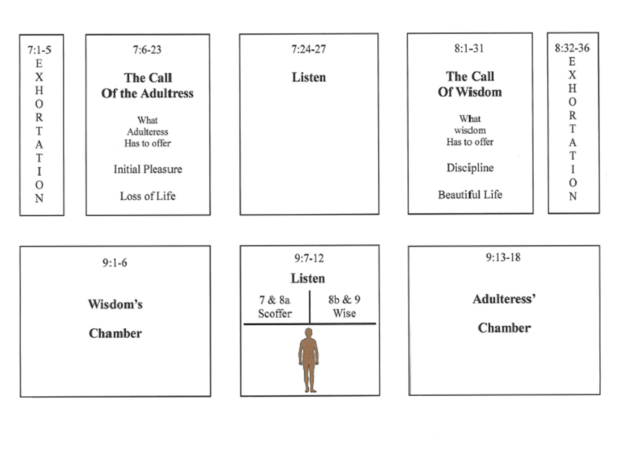
You will find that very articulate people can argue for very sinful positions. Yet, they don’t have pointy teeth or a maniacal laugh. Folly is very good at camouflaging itself. So how do we distinguish between them so that we might accept Wisdom and reject Folly? This is the subject of Proverbs chapter 9. As a reminder, the structure of this conclusion is as follows (a): 

We begin with a picture of Wisdom’s chamber:

9:1 Wisdom has built her house;
    she has set up its seven pillars.
She has prepared her meat and mixed her wine;
    she has also set her table.
She has sent out her servants, and she calls
    from the highest point of the city,
    “Let all who are simple come to my house!”
To those who have no sense she says,
    “Come, eat my food
    and drink the wine I have mixed.
Leave your simple ways and you will live;
    walk in the way of insight.”

(Prov 9:1-6, NIV)

In these first few verses we see that Lady Wisdom has built her house on seven pillars, a foundation for an exceptionally large structure with plenty of room for guests, including you. She has also prepared for you a feast. What exactly is that feast? We will discuss this more below, but first, let’s drop down to verse 13 where we find a description of “Dame Folly.”

13 Folly is an unruly woman;
    she is simple and knows nothing.
14 She sits at the door of her house,
    on a seat at the highest point of the city,
15 calling out to those who pass by,
    who go straight on their way,
16     “Let all who are simple come to my house!”
To those who have no sense she says,
17     “Stolen water is sweet;
    food eaten in secret is delicious!”
18 But little do they know that the dead are there,
    that her guests are deep in the realm of the dead.

(Prov 9:13-18, NIV)

Did you notice the similarities between these two women? Lady Wisdom sends her maidens to call “from the highest point of the city.” (v. 3) Where is Dame Folly? Verse 14 says she too is at the “highest point of the city.” Both women are at the same place, they both have access to the same audience, and their message is essentially the same as well. Lady Wisdom says, “Let all who are simple come to my house!” To those who have no sense she says…” (v 4) Dame Folly says what? “Let all who are simple come to my house!” To those who have no sense she says,” (v 16) The Hebrew words in these two verses are virtually identical. (b) In light of this, how do we distinguish between them so that we might accept Wisdom and reject Folly? That is the million dollar question. The wise and careful reader will notice several dissimilarities.

First, one major difference is that Wisdom works diligently – whereas Folly is “all talk.” Notice in the first 6 verses there are many verbs to describe Wisdom’s hard work. She has “built, hewn, prepared, mixed, set, sent, and called.” She has slaughtered her animals for the feast. She has made great effort. Dame Folly – what does she do? In verses 13-15, did you notice that there are no action verbs listed? There is no meat, no mixed wine, no set table and no sent messengers. Wisdom is action-oriented and proactive, whereas Folly is just boisterous and basically has a big mouth. David Hubbard says in his commentary on Proverbs, “Folly is portrayed as a woman who overcompensates for her ignorance by raucous talk and wanton conduct.” (c)

Here is a dead give away. If you are facing a fork in the road and trying to discern between wisdom and foolishness, the path of wisdom will always be the harder path, requiring more effort and conscientiousness. The foolish path will promise ease and pleasure, but it will almost always be too good to be true. 

Secondly, notice the differences in their menu. Wisdom’s diligent work has made a feast of food and mixed wine. (Mixed wine was a special wine where spices were added to make it more flavorful). On the other hand, Dame Folly offers only stolen bread and water (v 17). Bruce Waltke notes that “stolen qualifies the sexual enjoyment as being taken from the married spouse to whom it rightfully belongs.” (d) Dame Folly offers a pilfered meal which represents the passing pleasures of sin. But what is this feast offered by Lady Wisdom? Again, Waltke states that the “feast” being referred to here – is the rest of the book of Proverbs! Of course! Proverbs 10-31 is a carefully collected anthology of wisdom, set up like a banquet that has been meticulously prepared for you as a table of choice foods from which you can find and enjoy nourishment and healthy choices for your life. 

Third, and most importantly, notice the vastly different outcomes. The reason why wisdom commands the naïve to forsake their folly is found in verse 6, “Forsake your folly and live.” On the other hand, the tragic punch line of Dame Folly’s foolishness is that the person who comes to her does not know that the dead are there (v 18). Solomon’s sobering point here is that Folly is not just innocent fun, or boys being boys, no … Folly brings death. (Rom 6:23). Wisdom leads to life – while Foolishness leads to death. There is a tug of war inside the heart of every human being for our deepest loyalties. Solomon has set before his son, and all of us, the choice of blessings or cursings, of life or death. Waltke states, “With a stern warning the sage draws the curtain on the prologue, hoping to provoke the uncommitted to choose the life he offers in the collections that follow.” (e) 

This choice before us lays at the center of chapter 9, the key to unlocking the lesson. There are two kinds of listeners to the book of Proverbs, both are found in verses 7-12.

Whoever corrects a mocker invites insults;
    whoever rebukes the wicked incurs abuse.
Do not rebuke mockers or they will hate you;
    rebuke the wise and they will love you.
Instruct the wise and they will be wiser still;
    teach the righteous and they will add to their learning.

10 The fear of the Lord is the beginning of wisdom,
    and knowledge of the Holy One is understanding.
11 For through wisdom your days will be many,
    and years will be added to your life.
12 If you are wise, your wisdom will reward you;
    if you are a mocker, you alone will suffer.

(Prov 9:7-12, NIV)

The two kinds of listeners are the teachable (v 11) or the unteachable (v 7). Solomon describes the foolish response as a hard-nosed rejection. A “mocker” is one who simply will not humble himself before any authority, not his parents, not his teachers, and sadly, not even before the Lord himself. The wise listener, who deserves to sit at Wisdom’s table, begins their learning with a love for learning and with the “Fear of the Lord” (v 10).

Teachers must choose their pupils wisely. It is better to spend your energies on those who are willing to listen. This section reminds us of Jesus’ words about the good soil (Mark 4:1-20), and about shaking the dust off our feet toward those who won’t listen (Mk 6:11). It is interesting to see in the gospels how often Jesus actually walked away from people who would not listen to him. He did not throw his pearls before swine. (Mt 7:6) 

THE LESSON

If we are honest, I believe we can all relate to both the teachable and the unteachable. Our hearts are sinful. This is why Solomon writes this lesson. He knows the call of Dame Folly is tempting and real. We must be aware of her. In fact, if you think you’re wise, you’re probably the fool. But, if you are keenly aware of how foolish you can be, then you are well on your way to becoming wise. 

To apply this lesson, let’s get specific. Where specifically are you tempted in your life to listen to the wrong voice and follow Dame folly? Is it with your tongue? Your sexual behavior? Your money? Is it with substance abuse? Is it with not working with diligence? Where does Folly call out to you and in what area have you been listening to her? As you think about that area – I want to give you a very specific challenge. Go to the feast of wisdom (found in Proverbs 10-31) and find food for your soul there. I challenge you to memorize one verse that addresses that specific topic of struggle for you. Find for your soul the richest of fare. Perhaps you can pick one of the proverbs listed below: 


Here are some examples of individual proverbs to memorize on a variety of topics:

Jealousy

A heart at peace gives life to the body, but envy rots the bones. (Prov 14:30)


Sexual Impurity

The one who commits adultery lacks sense; whoever does so destroys himself.  (Prov 6:32)


Uncontrolled Anger

Like a city that is broken into and without walls Is a man who has no control over his spirit.  (Prov 25:28)


Pride and Boasting

Let another praise you and not your own mouth. A stranger and not your own lips. (Prov 27:2)


Alcohol and Substance Abuse

Wine is a mocker and strong drink a brawler, and whoever is intoxicated by it is not wise.  (Prov 20:1)


Taming the Tongue 

Reckless words pierce like a sword, but the tongue of the wise brings healing. (Prov 12:18)


Food Addiction and Overeating  

Put a knife to your throat if you are given to gluttony. (Prov 23:2)


Greed and Financial Corruption

Those who trust in their riches will fall, but the righteous will thrive like a green leaf. (Prov 11:28)


People-Pleasing and Approval Addiction

Fear of man will prove to be a snare, but whoever trusts in the LORD is kept safe. (Prov 29:25)


Laziness and Sloth

A little sleep, a little slumber, a little folding of the hands to rest. So shall your poverty come like a prowler, and your need like an armed man. (Prov 24:33-34)

For more teaching on the book of Proverbs from the ministry of Millington Baptist Church, visit our sermon archive page here


The Ten Lessons of Wisdom: 


REFERENCES: 

(a) I am indebted to Professor Peter Hook for this structural observation. OT Poetic Books. Course Notes. Philadelphia Biblical University, 2000.

(b) I am indebted to Pastor Craig Schill for this observation in his sermon on Proverbs 9.

(c) David Hubbard, Proverbs, The Preacher’s Commentary, Vol 15 (Nashville: Thomas Nelson, 1989) 137.

(d) Bruce Waltke, The Book of Proverbs: Chapters 1-15 (Grand Rapids: Eerdmans, 2005), 446. 

(e) Bruce Waltke, The Book of Proverbs, 446.

Conclusion: Two Invitations from Wisdom and Folly (Prov 7:1-9:18) – Part 2

The beginning of Proverbs contains 10 lessons of wisdom, followed by a dramatic conclusion. This blog post will examine part 2 of that conclusion, chapter 8. As a reminder, the structure of this conclusion is as follows (a): 

It’s not enough to simply tell someone (or one’s self) to stop foolish behaviors. When it comes to any sinful compulsion, will power alone does not lead to effective, long-term, lasting change. This is the problem with behavioral modification (“Stop it!” – Bob Newhart anyone?) It’s not enough. Deeper work is required, we need to look at our most profound desires. We need what theologian Thomas Chalmers called “The expulsive power of a new affection.” This is why Solomon crafts the beautiful picture of Lady Wisdom.

Commentator David Hubbard explains that the aim of Proverbs chapter 8 is to accentuate wisdom’s worth. She is attractive, resourceful and her credentials are off the charts. (c) The two great poems of Proverbs chapter 7 and Proverbs chapter 8 stand in stark contrast. Lady Wisdom is presented as a woman of high class, dignity and respect, whereas “Dame Folly” is presented, as an adulteress, or as a “Lady of the Night.” Dame Folly moves covertly at dusk, Lady wisdom moves publicly and shouts in broad daylight. Verse one begins with a rhetorical question, drawing the audience in to the poem.

8:1 Does not wisdom call out?
    Does not understanding raise her voice?
At the highest point along the way,
    where the paths meet, she takes her stand;
beside the gate leading into the city,
    at the entrance, she cries aloud:
“To you, O people, I call out;
    I raise my voice to all mankind.
You who are simple, gain prudence;
    you who are foolish, set your hearts on it.
Listen, for I have trustworthy things to say;
    I open my lips to speak what is right.
My mouth speaks what is true,
    for my lips detest wickedness.
All the words of my mouth are just;
    none of them is crooked or perverse.
To the discerning all of them are right;
    they are upright to those who have found knowledge.
10 Choose my instruction instead of silver,
    knowledge rather than choice gold,
11 for wisdom is more precious than rubies,
    and nothing you desire can compare with her.

(Prov 8:1-11, NIV)

Notice the contrast. Dame Folly speaks falsely (7:21), whereas Lady Wisdom speaks truthfully, directly, and authoritatively (8:7). Dame Folly is manipulative and coy (7:15-20), whereas Lady wisdom has no need to pervert because she has no self-serving agenda (8:8). Dame Folly’s speech is sweet in the beginning, but bitter in the end (7:22-23), Lady Wisdom’s speech demands discipline in the beginning, but promises life in the end (8:18-21). She continues:

12 “I, wisdom, dwell together with prudence;
    I possess knowledge and discretion.
13 To fear the Lord is to hate evil;
    I hate pride and arrogance,
    evil behavior and perverse speech.
14 Counsel and sound judgment are mine;
    I have insight, I have power.

15 By me kings reign
    and rulers issue decrees that are just;
16 by me princes govern,
    and nobles—all who rule on earth.
17 I love those who love me,
    and those who seek me find me.
18 With me are riches and honor,
    enduring wealth and prosperity.
19 My fruit is better than fine gold;
    what I yield surpasses choice silver.
20 I walk in the way of righteousness,
    along the paths of justice,
21 bestowing a rich inheritance on those who love me
    and making their treasuries full.

(Prov 8:12-21, NIV)

Here we see her wisdom is worth its weight in gold. What would be a greater treasure than to have a personal vault stocked with these precious treasures? This is exactly what the book of Proverbs claims to be. Notice in verse 17, we do not have a passive role, we learn that Lady Wisdom only loves those who love her. While Wisdom offers herself to all of humanity, “her offer is efficacious only for those whose hearts have been regenerated to love her.” (b) We must pursue her with effort. 

In this next section, (v 22-31) we will learn that Wisdom’s origin was from ancient days, from before even creation, as she existed first, before any other creature.

22 “The Lord brought me forth as the first of his works,
    before his deeds of old;
23 I was formed long ages ago,
    at the very beginning, when the world came to be.
24 When there were no watery depths, I was given birth,
    when there were no springs overflowing with water;
25 before the mountains were settled in place,
    before the hills, I was given birth,
26 before he made the world or its fields
    or any of the dust of the earth.
27 I was there when he set the heavens in place,
    when he marked out the horizon on the face of the deep,
28 when he established the clouds above
    and fixed securely the fountains of the deep,
29 when he gave the sea its boundary
    so the waters would not overstep his command,
and when he marked out the foundations of the earth.
30     Then I was constantly at his side.
I was filled with delight day after day,
    rejoicing always in his presence,
31 rejoicing in his whole world
    and delighting in mankind.

(Prov 8:22-31, NIV)

Note – Some theologians throughout church history (such as Arius) have sought to identify this poem about Wisdom as being about Jesus Christ, the second person of the Trinity. As intriguing as that would be, there are some major theological issues with that perspective. For example, the phrase “brought me forth” (in v 22, in Hebrew – “qana”) seems to convey that Wisdom here is actually not claiming to be eternal, as the orthodox teaching about Christ does (see John 1:1). If this is the case, this poem cannot be a direct referent to Jesus. It is probably best not to see Wisdom as equal to Jesus, but rather as an attribute of God displayed in creation, and further demonstrated in the person of Jesus, the ultimate Sage par excellence, in whom are all the treasures of wisdom and knowledge (Col 2:1-3).

The point of this poem is about wisdom’s uniqueness and priority, because she has a long and trustworthy history. Verses 27-31 is one extended sentence, the main point being, “I was there.” (v 27). She was there at creation, “wholly delighting” in the work of God, particularly the apex of which being the creation of humanity (v 31).

The main point of this poem is that Wisdom is valuable in that she has heavenly experience. Bruce Waltke states it well, “She is at home with both God and humanity, and as such mediates heaven’s wisdom to people on earth.” (c)  In light of her stature, we turn to the exhortation:

32 “Now then, my children, listen to me;
    blessed are those who keep my ways.
33 Listen to my instruction and be wise;
    do not disregard it.
34 Blessed are those who listen to me,
    watching daily at my doors,
    waiting at my doorway.
35 For those who find me find life
    and receive favor from the Lord.
36 But those who fail to find me harm themselves;
    all who hate me love death.”

(Prov 8:32-36, NIV)

The beauty of the poem of Proverbs chapter 8 is that it is true. This is an essential feature of all good art. It must be true.

In ch. 7 and ch. 8, Solomon has painted for us two word pictures, both of them beautiful in their own way. You may ask, how can chapter 7 (a picture of prostitution and adultery) be beautiful? It’s beautiful because he paints the picture as something horrible and not good. It is beautiful because it is true.

As an aside, this is actually the primary problem with pornography. It is not just filthy and perverse, it is also not true. The root word “Porn” means “wicked,” and the root word “graph” means “writing.” Thus, pornography at its core is an “wicked drawing.” The reason it is wicked is because it is a lie! It is painting a picture of decay, as if it were happy and life-giving. But this is not congruent with what we know about illicit sex, its consequences or any of its effects, it’s not reality, it’s a lie. 

Sex outside of marriage will not lead to any kind of “good life” or happiness, because there is no covenant commitment. The problem with the adulteress is that she is married to another man (7:18). The entire relationship with her is one big charade. She intends to remain married, even though she is being unfaithful. The temptress promises sexual love without erotic restraint, but she refuses to make the fundamental commitment to the young man that is required for real love to be possible. She is a liar. This is not true love. This is not what you are made for.

A relationship with Lady Wisdom on the other hand, is satisfying in that she tells us the truth. She deserves our full and unwavering allegiance, and we ought to choose to be in relationship with her because of her track record of faithfulness. The poem of chapter 8 is that her beauty and worth simply cannot be measured. Wisdom can be counted on. She has made promises to you that can be trusted. You should commit your life to her, because she is worthy.

THE LESSON

The lesson is clear, we find life and blessing in a committed covenant relationship with Lady Wisdom.

Next we will draw this blog series to a close by looking at Proverbs chapter 9 in Part 3 of this conclusion. 


The Ten Lessons of Wisdom: 


REFERENCES:

(a) I am indebted to Professor Peter Hook for this structural observation. OT Poetic Books. Course Notes. Philadelphia Biblical University, 2000.

(b) David Hubbard, Proverbs, The Preacher’s Commentary, Vol 15 (Nashville: Thomas Nelson, 1989).

(c) Bruce Waltke, The Book of Proverbs: Chapters 1-15 (Grand Rapids: Eerdmans, 2005), 423. 

Conclusion: Two Invitations from Wisdom and Folly (Prov 7:1-9:18) – Part 1

The beginning of Proverbs (Ch. 1-9) contains 10 didactic poems, featuring 10 lessons of wisdom, these are concluded with a dramatic grand finale (Ch. 7-9). In his final exhortation, the father graphically portrays Wisdom and Folly as two women, one a faithful and loving spouse, the other, an unfaithful and self-seeking adulteress. Throughout church history, these two women have been known as “Lady Wisdom” and “Dame Folly.” As you read this section, consider today that like the son, both of these women are in your life. They both call out to you and they both vie for your attention. Like the son, you too must choose who to follow.

The son must choose to which woman he will ultimately pledge his allegiance. What we will see here in chapters 7-9 is a contrast. These two women could not be more different. We will see a dichotomy involving two invitations, two ways, and two end results. His decision at this fork in the road will be destiny-shaping and life-altering. This chart is a helpful macro-level structure of this final word. (a)

Technical folks will notice this structure is “chiastic,” which just means it follows an inverted A-B-B-A format. This was a technique in Hebrew poetry used often to highlight what was in the center. In this case, the center is the father’s call to his son to “listen.”

7:1 My son, keep my words
    and store up my commands within you.
Keep my commands and you will live;
    guard my teachings as the apple of your eye.
Bind them on your fingers;
    write them on the tablet of your heart.
Say to wisdom, “You are my sister,”
    and to insight, “You are my relative.”
They will keep you from the adulterous woman,
    from the wayward woman with her seductive words.

(Prov 7:1-5, NIV)

In the first 5 verses we see the father’s exhortation to his son to embrace his teachings and this will result in enjoying the good life. (“and you will live” v 2). Our culture teaches us that a life without restriction leads to happiness, but the father says true freedom is a life lived within the boundaries of the law. These are “the boundaries that free.”

The wise son should accept “Lady Wisdom” into his life, as if she were a member of his own family (“You are my sister”). This means that the son should reject the call of the “wayward woman.” Some translations call her a “strange” woman.

What does this word “strange” mean? It might better be translated as “alien.” But based on other features found in ch 1-9, this can’t be that the woman is of a different race. Instead, it’s that her behaviors are “alien” to the son’s true nature. She is not calling the son to behave the way he was designed to live.

The adulteress seeks to seduce gullible, simple, and naïve men with initial pleasures that will lead to dramatic consequences, we meet her beginning in verse 6. Here we will see the father making an elevated observation of her behavior from the second floor of a two-story house. He is peering through a wooden lattice, or a shutter, through which he can see without being seen (it would function like tinted glass).

At the window of my house
    I looked down through the lattice.
I saw among the simple,
    I noticed among the young men,
    a youth who had no sense.
He was going down the street near her corner,
    walking along in the direction of her house
at twilight, as the day was fading,
    as the dark of night set in.

(Prov 7:6-9, NIV)

The young man in view does not have a firm commitment to the right way, and so he therefore puts himself in moral jeopardy. He lacks “sense.” (v 7). He is approaching her home ominously in the darkness of night, and we the readers fear that the fate of her victim will not be pleasant.

Notice in v 10, she comes out to him dressed as a harlot and wearing a veil, to mask from the public her true identity as a married woman and the wife of a wealthy merchant. To the sage, her shameless outfit betrays her hidden intentions, but to the naïve youth, it is like camouflage.

10 Then out came a woman to meet him,
    dressed like a prostitute and with crafty intent.
11 (She is unruly and defiant,
    her feet never stay at home;
12 now in the street, now in the squares,
    at every corner she lurks.)

(Prov 7:10-12, NIV)

Next we will see her “call” which is really more of a seduction. Bruce Waltke describes Dame Folly this way: “She is a defiant, noisy, and brash huntress seeking prey on the streets of the city that leads her victims to the grave. Tragically, the gullible dimwit who refused to listen to the wise obeys her.” (b) In verse 13, it says her face is brazen, which speaks to her shamelessness about her deceptive behavior.

13 She took hold of him and kissed him
    and with a brazen face she said:

14 “Today I fulfilled my vows,
    and I have food from my fellowship offering at home.

(Prov 7:13-14, NIV)

Do not be deceived by her affection. Solomon tells us elsewhere that “an enemy multiplies kisses.” (Prov 27:6) Then, of all things, this woman tells the young man that she is in need of a partner for religious reasons (v 14). The “offering” referred to here was a pagan practice, perhaps a Canaanite fertility cult activity, where she would have made a vow to a foreign god and needs a male partner for sexual intercourse to fulfill that vow. As a parasite, she is just using this young man to satisfy her own desires and lusts. She does not desire to serve her creator, or her husband. She has chosen a counterfeit god as her source of security. Dame Folly uses her words to manipulate this naïve young man. In verse 15, she flatters his ego with her words, paraphrasing here, saying “I just want you, you good-looking hunk of a man!” She has prepared her bed with aphrodisiac smells.

15 So I came out to meet you;
    I looked for you and have found you!
16 I have covered my bed
    with colored linens from Egypt.
17 I have perfumed my bed
    with myrrh, aloes and cinnamon.
18 Come, let’s drink deeply of love till morning;
    let’s enjoy ourselves with love!
19 My husband is not at home;
    he has gone on a long journey.
20 He took his purse filled with money
    and will not be home till full moon.”

21 With persuasive words she led him astray;
    she seduced him with her smooth talk.

(Prov 7:15-21, NIV)

Since she is married to another man (v 19), who is likely away traveling on business, this is a one-night stand, purely a sexual indulgence. With her lecherous words, she promises the young man safety, her husband is away and there will be no consequences, reminding the reader of the lies of the devil in the garden when he tempts Adam and Eve to sin saying, “You will not die!” (Gen 3:4). Cut from the same cloth as our original parents, the young man falls for her bait and doesn’t see the hook. Like so many adolescent boys, he acts without reflection and let his glands do his thinking for him. He has fallen for her trap.

22 All at once he followed her
    like an ox going to the slaughter,
like a deer stepping into a noose
23     till an arrow pierces his liver,
like a bird darting into a snare,
    little knowing it will cost him his life.

(Prov 7:22-23, NIV)

The father’s word pictures in v 22-23 are gripping and horrifying. These three stupid animals (the ox, the steer and the bird) are all deceived by the hunter. They see no connection between the traps that are set for them and their violent, unnatural deaths. The woman will conquer or “topple” him. The word “pierced” (v 23) was actually a military term for being wounded in battle. Her bedroom is in reality a warzone with carnage and dead bodies everywhere. With that said, now we are ready for the father’s strong exhortation:

24 Now then, my sons, listen to me;
    pay attention to what I say.
25 Do not let your heart turn to her ways
    or stray into her paths.
26 Many are the victims she has brought down;
    her slain are a mighty throng.
27 Her house is a highway to the grave,
    leading down to the chambers of death.

(Prov 7:24-27, NIV)

The father’s passionate exhortation is clear: Indulging with “Dame Folly” will lead to catastrophic consequences. But here is where her deception lies. There is a “gap” that exists between our choices and our consequences. We know from experience that not every foolish choice immediately results in death. In fact, sometimes it appears that there are no consequences at all. This is the trap of Dame Folly. She exploits the gap. She wants you to forget where her foolish behavior leads, and enjoy pleasure while you slip into a life of sheer mayhem. Make no mistake, joining her is a dance with death. If this is true, and it is, why would you want to even take one step toward her house?

THE LESSON

Reject Dame Folly’s seductive invitation. Do not even listen to her. Ah, yes, remember, all of this began with “listening.” This leads us to the key piece of advice, who or what are you “listening” to? The wise son will learn to “listen” to the call of “Lady Wisdom.” Her call is what follows in chapter 8.

We will examine this section next in part 2.


The Ten Lessons of Wisdom: 


REFERENCES

(a) I am indebted to Professor Peter Hook for this structural observation. OT Poetic Books. Course Notes. Philadelphia Biblical University, 2000.

(b) Bruce Waltke, The Book of Proverbs: Chapters 1-15 (Grand Rapids: Eerdmans, 2005), 367.

Lesson # 10: “If You Play With Fire, You Will Get Burned.” (Prov 6:20-35)

The beginning of Proverbs (Ch. 1-9) contains 10 lessons of wisdom. Here in this post we will examine the tenth and final lesson before the conclusion or grand finale, “Two Invitations: Wisdom vs. Folly (Prov 7:1-9:18).” 

Lesson # 10 is a warning against the sin of adultery. The need to say “no” to sex outside of marriage has been a dominant theme in these wisdom speeches. As is typical, this didactic poem employs synonymous parallelism throughout and begins with the words, “My son.”  We are introduced to three characters here:

  1. The “Prostitute”: a woman who engages in sexual activity for payment, feeding on the loneliness, lust and insecurity of men (v 26).  
  2. The “Adulteress”: a married woman who engages in sexual activity outside of marriage and is unfaithful to her husband (v 24, 29).
  3. The “Cuckold”: the betrayed (and angry) husband of the adulteress, the man whose wife has been unfaithful to him with another man (v 29, 34-35).

Entanglements with any of these three characters will lead to the son’s demise.

20 My son, keep your father’s command
    and do not forsake your mother’s teaching.
21 Bind them always on your heart;
    fasten them around your neck.
22 When you walk, they will guide you;
    when you sleep, they will watch over you;
    when you awake, they will speak to you.
23 For this command is a lamp,
    this teaching is a light,
and correction and instruction
    are the way to life,
24 keeping you from your neighbor’s wife,
    from the smooth talk of a wayward woman.

(Prov 6:20-24, NIV)

This introductory section resembles the great “Shema” (from Deut 6:3-6), as the son is told to bind the teaching around his heart and his neck. The imagery means memorizing these words of wisdom in such a way that they become permanently impressed on his mental and spiritual being. The father’s wisdom is to be not just learned, but internalized. When it is, it will become an inner lamp, illuminating the son’s path with guidance from the divine and provide protection. Notice the interplay with the word “keep” (or “guard”), the father says to “guard” (v 20) the teaching, and then the teaching will “guard” (keep) you (v 24).

25 Do not lust in your heart after her beauty
    or let her captivate you with her eyes.

(Prov 6:25, NIV)

The danger in mind here is the “wayward woman,” a hazard which begins in the heart of the son, with his own lust. This is why Jesus taught that adultery takes place in the human heart (Matt 5:27-28). Human sin always starts in the imagination (James 1:14-16). This is why the last of the ten commandments (the close of Decalogue) has to do with the sin of coveting (Ex 20:17), including that of another man’s wife. Notice here it begins with seemingly innocent eye contact, the father speaks of her eyelids as an embellished picture of her charm. Don’t fall for her tricks.

26 For a prostitute can be had for a loaf of bread,
    but another man’s wife preys on your very life.

(Prov 6:26, NIV)

Here a “prostitute” is distinguished from a married woman, or adulteress, the former is satisfied with a relatively small payment, whereas the latter hunts for the son’s precious life. (Note – the first part of verse 26 is difficult to translate and also interpret. It may read “on account of a prostitute you are reduced to a loaf of bread” making the son the one who is devalued. This may be the case.) Nonetheless, the argument the father is making is clear, there is severe danger with adultery. Bruce Waltke observes that the price of adultery is severe, inevitable, and unending. (a)

27 Can a man scoop fire into his lap
    without his clothes being burned?
28 Can a man walk on hot coals
    without his feet being scorched?

29 So is he who sleeps with another man’s wife; no one who touches her will go unpunished.

(Prov 6:27-29, NIV)

Here the inevitability of danger is put on display with two illustrations involving fire. With rhetorical questions, engaging the listener in thoughtful participation, the reader is expected to answer both negatively with “of course not!” If you touch a blazing oven, you will be seared for life. Next, the father compares and contrasts the sin of adultery and the sin of theft…

30 People do not despise a thief if he steals
    to satisfy his hunger when he is starving.
31 Yet if he is caught, he must pay sevenfold,
    though it costs him all the wealth of his house.
32 But a man who commits adultery has no sense;
    whoever does so destroys himself.
33 Blows and disgrace are his lot,
    and his shame will never be wiped away.

34 For jealousy arouses a husband’s fury,
    and he will show no mercy when he takes revenge.
35 He will not accept any compensation;
    he will refuse a bribe, however great it is.

(Prov 6:30-33, NIV)

If one commits theft, the criminal would often pay back double, in order that he should be defrauded the same amount he intended to take from his victim. Even if he stole because of hunger, still there would be a punishment, it says he would pay back sevenfold! However, when it comes to adultery, there is no price tag that would ever bring satisfaction for the husband’s anger.

The sin of adultery was met with capital punishment (Lev 20:10). The day when he takes revenge, or the day of vengeance (probably the day in court) would be brutal. Four times the word “not” is repeated at the end here, he will not take a bribe, he will not receive mercy, he will not take any compensation and his shame will never be wiped away. The cuckold wants nothing less than his very life. There will be no bribe, he wants his full pound of flesh in court. The son will be left with nothing but the inner guilt and shame, a form of walking death.

The Lesson

The lesson here for the son is obvious, guard against the sin of adultery. There are a few reasons for this: First, it is hurtful, women are degraded by this conduct, and men are betrayed by this infidelity. Second, it goes against God’s design. God has designed for physical intimacy to be enjoyed within the boundaries of marriage and covenant love. Third, it is living a lie. Allowing yourself to be vulnerable physically with someone, or asking them to be vulnerable physically with you, while at the same time holding back any true commitment to that person is not true love. It is living a lie, a dual-life. To say physically, “I am giving myself to you,” while at the same time holding back emotional, financial, and spiritual parts of yourself is to lack integrity and to live a double-life. This is the deepest problem. It is not a life of integrity. 

To the single, Solomon would say patiently wait for God’s best. To the married, Solomon would say guard against the sin of adultery, beware of rekindling old romances or flirting with new ones. Beware the dangers of the internet and social media. To those in caring professions (therapists, counselors, pastors, social workers), watch out for transference and counter transference in your line of work. Put a guard around your life and be protected from this sin of adultery, or you will lose more than you would ever want to give up.

If you play with fire, you will get burned. 

Stay Tuned! Next time we will consider the grand finale to the father’s lessons for his son, in The Conclusion: Two Invitations from Wisdom and Folly (Prov 7:1-9:18). In this final dramatic conclusion, the father moves from the concrete to the abstract. The wayward woman, still a very real threat, will become a symbolic representation, she becomes iconic, a larger than life figure, she becomes Folly personified. who seduces the son toward a way of life that is foreign and destructive. She is “Dame Folly.”

We will meet her next time in the conclusion – part 1.


The Ten Lessons of Wisdom: 


References:

(a) Bruce Waltke, The Book of Proverbs: Chapters 1-15 (Grand Rapids: Eerdmans, 2005), 353.

Lesson # 9: “Avoid three Kinds of Fools: “The Swindler,” “The Sluggard” and “The Sociopath.”” (Prov 6:1-19)

The beginning of Proverbs (Ch. 1-9) contains 10 lessons of wisdom. This blog post will examine Lesson # 9. In the book of Proverbs, the “fool” is often used generally to describe the opposite of the wise, but here the father-sage gets more specific and he covers three different types of fools: “The Swindler” (6:1-5), “The Sluggard” (6:6-11) and “The Sociopath” (6:12-19). (1) As you read these sections, ask yourself if you have encountered this type of fool in your life. The wise person needs to know about these different types of fools so that you can first, recognize them, second, so that you can stay far away from their destructive influence in your life, and last, so that you know to never become like them. First, we meet “The Swindler”:  

6:1 My son, if you have put up security for your neighbor,
    if you have shaken hands in pledge for a stranger,
you have been trapped by what you said,
    ensnared by the words of your mouth.
So do this, my son, to free yourself,
    since you have fallen into your neighbor’s hands:
Go—to the point of exhaustion—
    and give your neighbor no rest!
Allow no sleep to your eyes,
    no slumber to your eyelids.
Free yourself, like a gazelle from the hand of the hunter,
    like a bird from the snare of the fowler.

(Prov 6:1-5, NIV)

The swindler is an impulsive, greedy type of fool who will want to rope you into their financial entanglements. A “security” or a “pledge” (v 1) was collateral for debt. Shaking hands (v 1), like today, was a gesture for sealing a financial agreement. While the modern day concept of cosigning and loans with interest is not exactly identical to the ancient practice described here, the basic idea was still the same. Borrowing, co-signing, and incurring foolish debt, the father says is a “snare.” In the animal kingdom, a snare or “trap” was a device which concealed its deadly danger, in order to take its victim by surprise. This is the nature of the world of consumer debt. It’s a trap! Notice in verse 3 the father’s imperative, “Do this!” He speaks with urgency, aiming to rouse his son to immediate action. If you’re not familiar with financial advisor Dave Ramsey, his explanation of this passage of Proverbs and getting “Gazelle Intense” in order to become debt free is really something you should see. Dave vividly describes the gazelles running away from their predators, and urges his audience to be just that motivated to get out of debt. Go here for more. Dave Ramsey says, “You can wander into debt … but you can’t wander out … no, you gotta run like you’re on fire!”

The spiritual problem with debt is you are presuming on the future. This is outside of your control. As such, the father implores his son, get out of debt now, get out of your friend’s debts, and get away and stay away from all these kinds of financial liabilities. Solomon tells us elsewhere, “The borrower is slave to the lender” (Prov 22:7). The swindler, the father tells his son, is not your friend, and he’s definitely not your role model. Set some boundaries with that guy. Say “No” to the swindler” and stay out of debt. Next, we meet his close cousin, “The Sluggard”:   

Go to the ant, you sluggard;
    consider its ways and be wise!
It has no commander,
    no overseer or ruler,
yet it stores its provisions in summer
    and gathers its food at harvest.

How long will you lie there, you sluggard?
    When will you get up from your sleep?
10 A little sleep, a little slumber,
    a little folding of the hands to rest—
11 and poverty will come on you like a thief
    and scarcity like an armed man.

(Prov 6:6-11, NIV)

“The Sluggard” is the type of fool who is characterized by laziness, a stubborn unwillingness to work and the chronic problem of never having enough money. Let me make a caveat, we are not talking about people who are poor because of circumstances beyond their control. These folks are of great concern to God (Prov 19:17). Instead, here we are talking about “self-inflicted” economic impoverishment. Look at the description. The sluggard’s love for sleep is his pure escapism, refusing to face the world. He withdraws from the pain of working and life in general. The sluggard prefers to rest. “I’ll get to that … sometime.” But he will not make or keep commitments, utterly frustrating everyone around him. Notice the exasperation in the questions, “How long will you …?” and “When will you …?” (v 9). He is driving everyone crazy. 

As in the first section, again the father looks to the animal kingdom for an illustration. Here he encourages the sluggard to study “the ant.” (Note, this term refers to the “harvester ant,” an insect which is always diligently at work storing its grain within its nest). The ant is an example of hard work, planning, and industry, without even a need to be exhorted by a supervisor. The sluggard needs to study the ant.

The warning given here is of perpetual want and poverty which was a great danger in their society without the kind of social programs we in America are familiar with today. The father tells his son plainly, “While your eyes are shut and your hands are folded, your poverty will take over you!” The main problem, like the swindler, is that the sluggard too is presumptuous. He needs to work while it is still day and while he still can. The old adage, ““Make hay while the sun shines” fits well. The sluggard needs to get a job and go to work. The apostle Paul says, “If a man will not work, he shall not eat” (2 Thess 3:10).

Finally, we meet “The Sociopath.”

12 A troublemaker and a villain,
    who goes about with a corrupt mouth,
13 who winks maliciously with his eye,
    signals with his feet
    and motions with his fingers,
14 who plots evil with deceit in his heart—
    he always stirs up conflict.
 (Prov 6:12-14, NIV)

This third kind of fool has turned to the dark side. The term “troublemaker” (v 12) literally in Hebrew is the word “Belial,” which was a term used to describe the devil himself (1 Cor 6:15)! Bruce Waltke calls him “The Insurrectionist” for his rebellion against God and extreme antisocial behavior. (2) He has become a violent, perverse, rabble-rouser. He is a slanderer who distorts the truth because of his diabolical thinking and sinister behavior.  His “winking” (v 13) here is a devious gesture that is malicious in its intent. His evil behavior is continual (“always,” see Gen 6:5). This person fits the description of what psychologists call a “Sociopath,” here are some well-known characteristics:  


CHARACTERISTICS OF A SOCIOPATH: (3) 

GRANDIOSE SELF-WORTH –a grossly inflated view of one’s abilities and self-worth.  Big egos. Sociopaths are people who believe they are superior human beings. They think they are smarter than others and therefore feel they can get away with their activity.

SUPERFICIAL CHARM — the tendency to be smooth, engaging, charming, slick, and verbally facile. They will charm his/her way into your life and heart, then take complete advantage of you – your emotions, your intellect, your finances.

NEED FOR STIMULATION OR PRONENESS TO BOREDOM — an excessive need for novel, thrilling, and exciting stimulation; taking chances and doing things that are risky.

PATHOLOGICAL LYING — in moderate form, they will be shrewd, crafty, cunning, sly, and clever; in extreme form, they will be deceptive, deceitful, underhanded, unscrupulous, manipulative, and dishonest.

CONNING AND MANIPULATIVENESS– the use of deceit and deception to cheat, con, or defraud others for personal gain; exploitation and callous ruthlessness is present. 

LACK OF REMORSE OR GUILT — a lack of empathy or concern for the losses, pain, and suffering of victims.

SHALLOW AFFECT — emotional poverty or a limited range or depth of feelings; interpersonal coldness in spite of signs of open gregariousness.

CALLOUSNESS and LACK OF EMPATHY — a lack of feelings toward people in general; cold, contemptuous, inconsiderate, and tactless.

PARASITIC LIFESTYLE — an intentional, manipulative, selfish, and exploitative financial dependence on others as reflected in a lack of motivation, low self-discipline, and inability to begin or complete responsibilities.

PROMISCUOUS SEXUAL BEHAVIOR — a variety of brief, superficial relations, a history of attempts to sexually coerce others into sexual activity.

POOR BEHAVIORAL CONTROLS — expressions of irritability, annoyance, impatience, threats, aggression, and verbal abuse; inadequate control of anger and temper; acting hastily.

IMPULSIVITY — the occurrence of behaviors that are unpremeditated and lack reflection or planning; inability to resist temptation,

IRRESPONSIBILITY – repeated failure to fulfill or honor obligations and commitments; such as not paying bills, defaulting on loans, performing sloppy work, being absent or late to work, failing to honor contractual agreements, failure to learn from mistakes.


If you are in a relationship with a sociopath, you know it is exhausting, maddening and even soul-crushing. They will isolate you from your friends and possibly your family. And on top of it all, despite the obviousness of their wrongs, they will make you think you are the crazy one. Because the Sociopath refuses to listen and turn away from evil, the only recourse is to set boundaries and allow them to experience the consequences of their actions, which are quite severe.

15 Therefore disaster will overtake him in an instant;
    he will suddenly be destroyed—without remedy.

(Prov 6:15, NIV)

Sadly, the Sociopath simply will not behave within the standards around which a civil society is built. He is overthrowing the divine order. As such, the father says the Sociopath must be broken, or “destroyed” (a harsh word used of a ship being wrecked, or the fracturing of the human neck). The picture here is sudden destruction, likely a sign of divine wrath. His behaviors boomerang back onto him and after which, he is so totally defeated that no one wants to be like him. The characteristics of a Sociopath are not just foolish or ethically wrong, the LORD hates them, and so Solomon finishes this sobering lesson with this riddle: 

16 There are six things the Lord hates,
    seven that are detestable to him:
17 haughty eyes,
        a lying tongue,
        hands that shed innocent blood,
18 a heart that devises wicked schemes,
        feet that are quick to rush into evil,
19  a false witness who pours out lies
        and a person who stirs up conflict in the community.

(Prov 6:16-19, NIV)

Here in these 7 things (an ancient memorable wisdom “riddle”), the father points out how this fool has misused his body parts for evil. Notice his description moving downward from the top of the fool’s head to the bottom of the fool’s feet, starting with the greatest abomination, his “haughty eyes,” the opposite of the fear of the Lord. The Sociopath denies the LORD’s authority (see Ps 101:5, Job 21:22, Isa 10:33) and will not be held accountable to anyone. At this point, he has become totally corrupt. 

The Lesson

The three fools in this lesson have much in common. All three are disruptive, all three break the bond of trust and confidence with others, and all three violate the honor and dignity of other human beings made in the image of God. The problem with all three fools is they do not reflect God’s likeness as they ought and all three exhibit a failure to love. For the swindler, his financial delinquency is selfish, for the sluggard, his laziness refuses to carry its own weight, let alone help with others. For the sociopath, he loves things, uses people and glorifies himself. The wise son will be just the opposite and instead use things, to love others and glorify God.

Furthermore, there may also be a progression in this foolish behavior. The swindler begins with greed and impulsive spending, followed by compulsive borrowing and trying to make easy money, he becomes the sluggard with an addictive reluctance to avoid hard work, and he ends up a sociopath, with an insidious web of all kinds of sinful behaviors to keep his racket going as long as possible – until God Himself has to intervene, “for the love of money is a root of all kinds of evil.” (1 Tim 6:10) 

Here in Lesson # 9, the father is warning his young son to watch out for these three kinds of fools. Watch out for get rich quick schemes and schemers. Instead, work hard. Be generous. This ought to be the normal routine for the Christian. Bruce Waltke puts all the teaching on “the righteous” in the book of Proverbs into a concise and practical principle: “The righteous are willing to disadvantage themselves to advantage the community; the wicked are willing to disadvantage the community to advantage themselves.” (d) 

If you are entangled with one of these fools, set boundaries and be wise. If you are behaving like one yourself, the path forward for you toward wisdom is repentance and humility. God is jealous for your heart. Return to Him.

“Submit yourselves, then, to God. Resist the devil, and he will flee from you. Come near to God and he will come near to you. Wash your hands, you sinners, and purify your hearts, you double-minded. Grieve, mourn and wail. Change your laughter to mourning and your joy to gloom. Humble yourselves before the Lord, and he will lift you up.” (James 4:7-10, NIV)

Avoid three Kinds of Fools: “The Swindler,” “The Sluggard” and “The Sociopath.”

Next we will examine Lesson # 10


The Ten Lessons of Wisdom: 


REFERENCES:

(1) I considered some other titles for this blog post like, “The Borrower,” “The Bum” and “Belial” and “The Debtor,” “The Do-Nothing,” and “The Devil” but ultimately landed here, feel free to use your own preferred titles. 

(2) Bruce Waltke, The Book of Proverbs: Chapters 1-15 (Grand Rapids: Eerdmans, 2005), 342-343.

(3) I am indebted to Professor Peter Hook at Philadelphia Biblical University for this insight. OT Poetic Books. Course Notes. 2000.

(4) Bruce Waltke, The Book of Proverbs, 97.