Fruit of the Spirit: Patience

Patience. When many of us think of patience we may have different ideas that come to mind. For some, they may think of patiently waiting on the phone with a slow customer service experience with a company. For others, they may think of being patient with a difficult student in class. And for some people, they may think of patiently waiting to receive their brand-new smartphone in the mail.

But when we take a closer look at the original Greek word for patience (makrothrumia) we see that it has to do with being patient with other people. Some translations use the word “forbearance” while some translations use the word “longsuffering”. In the Old Testament, God’s patience is often described as him being “slow to anger”.

It helps to think of being “slow to anger” as a spectrum where on the one end of the spectrum we have “blow anger” and on the other end of the spectrum we have “no anger”.

So, on the one end of the spectrum we have “no anger” and this is in fact a form of impatience. But we may ask, “What’s the big deal with no anger? Isn’t that a good thing? Come on – surely this must be okay…right?”.

Well, Exodus 34:6 says this, 6 The Lord passed before him and proclaimed, “The Lord, the Lord, a God merciful and gracious, slow to anger, and abounding in steadfast love and faithfulness”[1]

What this scripture makes clear is that God is not void of anger; rather, he is SLOW to anger. As we see in this scripture God is not only slow to anger, but he is also abounding in steadfast love and faithfulness.

Therefore, responding to someone with “no anger” is not faithful and not loving because it fails the other person. Someone with “no anger” fails the other person by not seeing the sinner behind the sin and when the other person wrongs them the person with “no anger” chooses not to patiently stick around with them to help them learn, grow, and change.

On the other end of the spectrum, we have “blow anger”. Now “blow anger” is pretty self-explanatory, it is the person who blows up with rage, who has a short fuse, and a quick temper. Some people may even ask, “Well what’s so bad with this? Why can’t I blow up with anger? I mean if the other person did something wrong then don’t they deserve it?”.

Well once again we need to look at that scripture from Exodus 34:6 which says, “6 The Lord passed before him and proclaimed, “The Lord, the Lord, a God merciful and gracious, slow to anger, and abounding in steadfast love and faithfulness”[2]

So, we see that God is not only slow to anger, but he is also merciful and gracious. And that is why “blow anger” is problematic. “Blow anger” shows the other person no grace and no mercy. “Blow anger” has complete tunnel vision as it just sees the need for immediate justice and vengeance. Once again, “blow anger” fails the other person by not seeing the sinner behind the sin and not patiently sticking around with them to help them learn, grow, and change.

But what exactly is patience? What does it mean to be “slow to anger”? Well, being “slow to anger” is most beautifully seen in Jesus Christ on the cross. On the cross we gave Jesus every reason to be impatient with us. Yet he did not blow up with rage and he did not walk away with indifference.

Rather, Jesus stayed on the cross and patiently endured the hard circumstances, completed his work on the cross and brought us redemption. And it was through this patience on the cross that he brought us new life in him. It was through this patience on the cross that he brought us back to God to be reborn as children of God.

Glory be to God that he saw us sinners behind our sin. Glory be to God that he chose to be patient with us and through that patience he saved us and gave us hope! May the patience we have received in the gospel move our hearts towards being more patient with others through the enabling power of the Holy Spirit!


Questions for Reflection

  1. What are some times in your life that you received patience from someone?
  2. What are some times in your life that your experienced God’s patience?
  3. Where are some areas in your life that you can live out “patience”?


Bibliography

[1] The Holy Bible (ESV)

[2] The Holy Bible (ESV)

Roe v. Wade is Overturned: How should Christians respond?

This week the U.S. Supreme Court has issued a ruling that overturned Roe v. Wade, effectively ending the nation’s constitutional right to abortion and sending the issue back to the states.

How should we as Christians make sense of this monumental news?

Here at MBC, we are passionate about life and we have prayerfully considered this issue for many years. In our MBC position paper on abortion, we state the following:

“Our desire is not to oppose the legitimate rights of women or to limit their options for the responsible care of the children to whom they give birth. We do want to protect the innocent because the Bible teaches,

  1. that God is the creator and sustainer of life, and that He forbids the unjust taking of innocent, human life (Gen. 2:7; 30:2,22; Ex. 20:13)
  2. that the living, but as yet unborn child is a person from the time of conception (Psalm 139:13; Jer. 1:5)
  3. that the unborn child stands under the protection of God’s commandment which says, “You shall not murder” (Ex. 20:l3)
  4. that it is the moral duty of every human being to protect and defend the innocent and defenseless from injustice (Prov. 24:11,12)
  5. that abortion, in that it destroys an innocent, human life, is not a moral option in matters of family planning, birth control, or dealing with an unwanted pregnancy

Because we hold these convictions, we encourage our members and friends,

  1. to secure for these defenseless and innocent persons the due protection of law from the deadly threat of abortion
  2. to offer as an alternative to the immoral choice of abortion, understanding and compassionate help to mothers who face a crisis pregnancy
  3. to provide assistance in opening hearts and homes for unwanted babies
  4. to offer the compassionate friendship and forgiveness available in Christ to those who have had an abortion
  5. to encourage agencies that will champion the needs of unborn children and their families, especially those that share the message of Christ as well as the resources for physical and emotional care
  6. to speak and act as responsible citizens in the social and political arenas of our nation on behalf of the living, but as yet unborn, whose lives are threatened by abortion
  7. to oppose the immoral view that abortion is an unquestioned “right” of citizens of this country
  8. to reject the stance that abortion, involving as it does an innocent victim, is a matter of personal privacy.

As men and women who are commanded to act on behalf of the Living Savior, we call all people:

  1. to repent of the callous and self—centered attitudes which have allowed us to ignore the plight of these innocent victims for so long
  2. to defend the sanctity, dignity, and worth of the unborn, from conception to birth
  3. to stand with us in conscience opposed to any different message based on human reasoning without regard for the word of God.”

What should we as Christians do? 

  • Pray fervently. Pray that in the days to come all life would be protected by our nation’s laws.
  • Care Compassionately: Love the women around you who are experiencing an unwanted pregnancy and need support and compassion in their time of fear and need.
  • Give financially. Support those on the front lines such as First Choice Women’s Resource Center.
  • Proclaim the Gospel boldly. Hope, forgiveness and healing comes through placing our faith in the gospel of Jesus Christ alone.

Here are some more resources on the Sanctity of Human Life:  

Aren’t Christianity and Science Incompatible?

We are going through a sermon series at church discussing different worldviews. Many people in our culture believe that faith and science are opposed to one another. They see them as either mutually exclusive or even incompatible. I want to argue that that they are not only compatible, but they are locked together in a logical sequence. In this essay, I will argue that modern scientific inquiry was built on top of the doctrines of Christian Theism.

Dr. Rebekah McLaughlin in her excellent book “Confronting Christianity”[1] points out that Dr. Hans Halvorson who is a professor of philosophy at Princeton, argues that not only did Christians throughout history invent science, but the reason they invented science was because they saw in the Scriptures a Creator God who is both rational and free.[2] In other words, when they looked around, they saw a God who provided order and who created principles or laws which govern the universe, such that we as His creatures might be able to discern these things. They believed nature was uniform and could be trusted to behave in predictable ways. But, since God is free, He could do this however He wanted to. Therefore, the only way to find out what those underlying rules are, is to “go and look.”
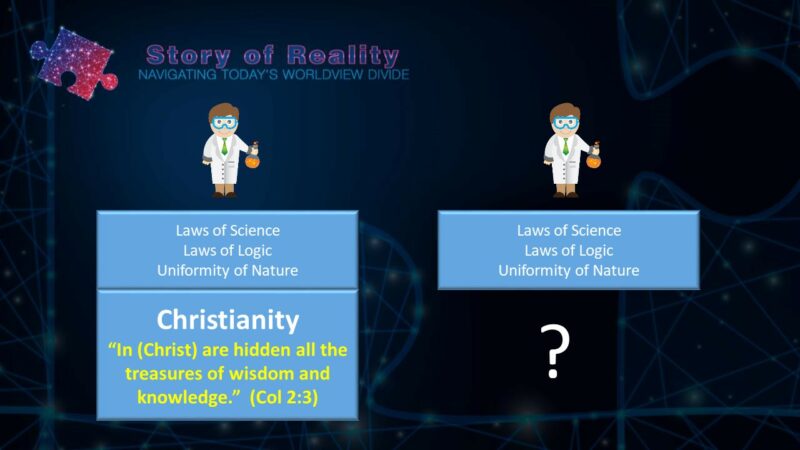
What the history of science suggests is that science assumes the existence of natural laws and presupposes the constancy of nature, but on what basis? I assert these assumptions of science stand on the foundation of Theism. Christians believe that God is unchanging (Mal 3:6) and that He governs nature by fixed patterns. (Gen 8:22) We believe He has entrusted us with stewardship and responsibility and given us language, senses and reasoning to live in His world. One intertestamental writer said it this way, “Thou hast ordered all things in measure and number and weight” (Wisdom of Solomon 11.20). To do science (as Johannes Kepler said) is to “think God’s thoughts after Him.” The scientific achievements of Isaac Newton (1642-1727) were summarized in poet Alexander Pope’s famous couplet:

“Nature and Nature’s laws lay hid in night

God said: ‘Let Newton be!” and all was light.”

Pope’s point is clear, that Newton discovered some of the fundamental laws of nature as given by God. Research professor Peter Harrison writes,

“What is often less appreciated, however, is that part of the novelty of Newton’s achievement lay in his conviction that there were laws of nature there in the first place, awaiting discovery…This idea – laws of nature in the scientific sense – was an innovation of the seventeenth century and was a consequence of the extension of God’s legislative moral power to the physical world. One of the pioneers of this new understanding of laws of nature was the French philosopher and scientist Rene Descartes (1596-1650), who wrote that “God alone is the author of all the motions in the world. Descartes thus argued that because these laws had their source in an eternal and unchanging God, the laws of nature must themselves be eternal and unchanging. Descartes also set out a law of the conservation of motion, again arguing for it on the basis of God’s immutability. This idea that nature was governed by constant and immutable principles was an important precondition for experimental science…Robert Boyle, the father of modern chemistry and author of the eponymous law, observed that God’s creation operates according to fixed laws “which He alone at first established.” God’s authorship of the laws of nature guaranteed their universality and unchanging nature.” [3]

The problem (for the secular scientist) is that science itself is based on these inherently Christian presuppositions. In other words, science is only possible because of the assumption that an unchanging God upholds the universe in this logical, orderly way. This same God made our minds able to think and reason logically. We assume nature’s laws (such as the law of gravity) and the laws of logic (such as the law of non-contradiction), but without God, people do so without accounting for them.

In other words, without a belief in God, we run into what’s called in philosophy the “problem of induction.” This problem asks the following questions: 1) What are the justifications, if any, for any knowledge beyond our mere observations? 2) How can anyone generalize based on a number of finite observations? 3) On what basis can we assume that the future will occur as it always has in the past? Philosopher David Hume argued that our reason alone cannot even establish the grounds of proving cause and effect. Hume presented this problem of induction in his work “A Treatise of Human Nature,” writing this:

“There can be no demonstrative arguments to prove, that those instances, of which we have had no experience, resemble those, of which we have had experience.”[4]

Where can we go to determine with any degree of certainty that empiricism (the reliance on the senses for information) is a trustworthy source of knowledge? And furthermore, where can we go to determine with any degree of certainty that rationalism (our ability to use logic and reason) is a verifiable source of knowledge? We are left with complete uncertainty without God’s promises. But this leaves us with a world in which no one can live consistently.

“If the foundations are destroyed, what can the righteous do?” (Ps 11:3, ESV)

Immanuel Kant (1724-1804) is responsible for introducing the term “transcendental” to philosophical discussion. All of us, he argued, must concede that knowledge is possible. Or else, there is no point to any discussion or inquiry. Now, given that knowledge is possible, said Kant, we should ask what the conditions are that make knowledge possible. What must the world be like, and what must the workings of our minds be like, if human knowledge is to be possible? The Transcendental argument became a staple of the writings of the idealist school that followed Kant, and from there it made its way into Christian apologetics. James Orr (1844-1913) employed it. But the twentieth-century apologist who placed the most weight on the transcendental argument (which he sometimes called “reasoning by presupposition”) was Dr. Cornelius Van Til (1895-1987) of Westminster Seminary. He, along with many of his students (Dr. Greg Bahnsen, Dr. John Frame, Dr. Scoff Oliphant) argued for the truth of Christian Theism based on “the Transcendental Argument for God.” (T.A.G.) Van Til would say that only Christianity provides the necessary preconditions for rational and scientific thought. He maintained that Christian theism is the presupposition of all meaning, all rational significance, and all intelligible discourse. Even when someone argues against Christian theism, Van Til said, he presupposes it, for he presupposes that rational argument is possible and that truth can be conveyed through language. The non-Christian, then, in Van Til’s famous illustration, is like a child sitting on her father’s lap, slapping his face. She could not slap him unless he supported her. Similarly, the non-Christian cannot carry out his rebellion against God unless God makes that rebellion possible. Contradicting God assumes an intelligible universe and therefore a theistic one.[5] The sure proof that God exists, Van Til would argue, is that “without Him, you can’t prove anything.”[6] His proof of God was based on “the impossibility of the contrary.”

This does not mean that secular scientists cannot make observations, use reason and do science, they can. But, they can do so only because they too live in God’s trustworthy world. The transcendental argument simply means that they have no philosophical justification for doing science. In other words, when scientists presuppose the laws of nature being uniform, they are borrowing from the Christian worldview (truth that comes from outside of the worldview of naturalistic materialism) when making these assumptions.

Evidence of the necessity of these assumptions can be found in the Bible, such as in Proverbs 1:7, “The fear of the Lord is the beginning of knowledge.” And, “All the treasures of wisdom and knowledge are hidden in Christ.” (Col 2:3) The Bible does make this kind of radical claim, that creation not only implies, but presupposes God. We must start with God, lest we become fools. (Ps 14:1, Rom 1:18-25, 1 Cor 1:20) For God is the creator of all, and therefore the source of all meaning, order, and intelligibility. It is in Christ that all things hold together (Col. 1:17). So without him everything falls apart; nothing makes sense. Therefore, the Bible teaches that God is not a God who is reasoned to, rather He is THE God that we (as finite human beings), simply cannot reason without. Belief in this Creator God who has revealed Himself through special revelation and most clearly in the person of Jesus Christ serves as a firm foundation for all of life and for scientific inquiry.

C.S. Lewis once said, “I believe in Christianity as I believe that the sun has risen: not only because I see it, but because by it I see everything else.”[7]

Everyone must start with assumptions when doing science, but only scientists from a Christian worldview have justification for doing so. Scientists who come from a Christian worldview can account for such knowledge and certainty based on the belief that God has revealed Himself as the trustworthy Creator and sustainer of all His creation. (Col 1:1-20)


(To learn more about these important worldview issues such as the relationship between science and faith, visit our sermon series webpage here.)


References:

Bahnsen, Greg, Always Ready: Directions for Defending the Faith (Atlanta: American Vision, 1996).

Frame, John, Apologetics to the Glory of God (Phillipsburg, NJ: P & R Publishing, 1994).

Frame, John, Cornelius Van Til (Phillipsburg, NJ: P & R Publishing, 1995).

Lewis, C.S. Mere Christianity. (New York: Macmillan, 1960).

McLaughlin, Rebecca. Confronting Christianity (Wheaton, IL: Crossway, 2019),

Oliphant, Scott. Covenantal Apologetics (Wheaton, IL: Crossway, 2013).

Pratt, Richard. Every Thought Captive: A Study Manual for the Defense of Christian Truth (Phillipsburgh, NJ, P & R Publishing, 1979).

Kant, Immanuel, Critique of Pure Reason, abridged, ed., tr., int.  by Norman Kemp Smith (N. Y.: 1958).

Van Til, Cornelius, The Defense of the Faith (Philadelphia: 1963).

Works Cited: 

[1] McLaughlin, Rebecca. Confronting Christianity (Wheaton, IL: Crossway, 2019), Ch. 7.

[2] Prof. Hans Halvorson, “Does the Universe Need God?” https://www.youtube.com/watch?v=SDwpTcSEjak Accessed July 14, 2021.

[3] Peter Harrison is a Research Professor at University of Queensland and a Senior Research Fellow at the Ian Ramsay Centre in Oxford, where for a number of years he was the Idreos Professor of Science and Religion. He has published many books on the history of science and is editor of The Cambridge Companion to Science and Religion. Quotation taken from https://www.abc.net.au/religion/christianity-and-the-rise-of-western-science/10100570 Accessed July 14, 2021.

[4] For more basic information about this philosophical problem, visit https://en.wikipedia.org/wiki/Problem_of_induction

[5] Van Til, Cornelius, The Defense of the Faith (Philadelphia: 1963).

[6] Van Til, Cornelius, The Defense of the Faith (Philadelphia: 1963).

[7] C.S. Lewis. Mere Christianity (New York: Macmillan, 1960).

Top Five Lessons from the Book of Hebrews

Almost 2,000 years ago, God inspired an amazing letter to be written, known today as the “Letter to the Hebrews.” We just concluded a sermon series through the book of Hebrews this Spring, and before we move on I want to share the top five lessons I’ve taken away from this amazing letter, this time around:

Lesson 1 – You can rest, because it is finished.

Reading this book makes you want to breathe out a sigh of relief. In terms of your salvation, you can rest by faith in the finished work of Christ on your behalf. Dr. Lewis Sperry Chafer used to say to his students, “Men, God is satisfied…Men, God is satisfied.” The work is done. The fact that Jesus sat down (Heb 10:12) means that His redemptive work for your sake was completed on the cross. In the Old Testament sacrificial system, there were no chairs in the temple because the high priest’s work was never finished. Today the High Priest of God, Jesus Christ, has completed the work at salvation by declaring that “it is finished” (John 19:30) Are you resting in His finished work? “Let us, therefore, make every effort to enter that rest.” (Heb 4:11)

Lesson 2 – You should work hard, because the warnings are serious.  

Reading this book also motivates you to get moving! This may sound like a contradiction with the first lesson, but it’s not. Let me explain. There are five major warning sections in the book of Hebrews (2:1-4, 3:7-4:13, 5:11-6:20, 10:26-39, 12:14-29) and they are all meant to spur you on toward greater maturity, love and good deeds. There are consequences for those who shrink back and look elsewhere for their security and significance in this life. It’s not that we earn favor with God through our good works, it’s that our works display our true allegiance. They are the fruit of our salvation, not the root of our salvation. The warnings are serious in nature, meaning, if you are a true follower of Jesus, your life should bear good fruit and display the authenticity of your commitment. If you do not display these qualities, there is reason to be greatly concerned both here and in the life to come. Are you striving toward maturity? “Let us go on!” (Heb 6:1)

Lesson 3 – You can trust, because God calls you to live by faith.

Reading this book makes you want to step out into the unknown. Following God is easy when everything makes sense and life seems easy. But you and I both know it’s not always like that. Have you ever read Hebrews 11? What do you do when life doesn’t make sense? Will you follow Jesus then? Will you be faithful then? That’s the test. Biblical faith not only believes that God exists (Heb 11:6), biblical faith also says “I have something real that I do not have right now.” (Heb 11:1) Biblical faith sometimes sees God do wonderful things (Heb 11:7-8), but it also allows God’s people to endure terrible things. (11:35b-40) The key here is that Biblical faith is not in our agenda for God, but in God’s agenda for us. (Heb 11:35-40) Do you live by faith? Remember, “Without faith, it is impossible to please Him.” (Heb 11:6)

Lesson 4 – You can endure, because this world is not your home. 

Reading this book makes you able to patiently wait. The book of Hebrews was originally written as a strong source of encouragement to first century believers to press on through difficulties because of the reward which was to come (Heb 10:34-35, 11:6, 40, 12:1-3). It encourages the readers to patiently endure suffering and prepares them for persecution (Heb 2:1, 4:14, 6:1-3, 10:23, 10:36 12:1-2), by exhorting them to live by faith in God’s promises of a better city, as the saints of God always had to do. We are all looking for the reward (Heb 11:26). This reward is pictured as a “city which is to come.” (Heb 13:14). This life is short. Eternity is long. Persevere and live for what’s in store in the next life. As C.T. Studd said, “Only one life, twill soon be past, only what’s done for Christ will last.” Are you going through a hard time? Live for that reward. “You have need of endurance.” (Heb 10:34-35)

Lesson 5 – You can be satisfied in Christ, because Jesus is Greater than all.

Reading this book makes you stand in awe and wonder of the second person of the Trinity. The book of Hebrews teaches about the absolute Supremacy of Jesus Christ. The adjective “better” is used 13 times, along with a cluster of words “more,” and “greater” appearing a combined total of 25 times. He is better than Angels (Ch. 1), Moses (Ch. 3), and Aaron (Ch. 4-7) His covenant is better (Ch. 8), His sacrifice is better (Ch. 9), and His temple is better (Ch. 10). The book of Hebrews encourages the worship of Christ for His person and work as the Heir, Creator, Sustainer, and our Prophet, Priest, and King. He is the climax of God’s revelation (Heb 1:1-3) He is worth your every effort! Whatever you are facing today, “Fix your eyes on Jesus.” (Heb 12:1-2) I concluded my final sermon with a collection of all we have learned about Jesus in this amazing letter, compiled by John Piper here.

He is:

  • God’s final revelation (1:2).
  • The heir of all things (1:2).
  • The creator of the world (1:2).
  • The radiance of God’s glory (1:3).
  • The exact imprint of God’s nature (1:3).
  • He upholds the universe by the word of his power (1:3).
  • He made purification for sins (1:3).
  • He sits at the right hand of the Majesty on High (1:4).
  • He is God, enthroned forever, with a scepter of uprightness (1:8).
  • He is worshipped by angels (1:6).
  • His rule will have no end (1:8).
  • His joy is above all other beings in the universe (1:9).
  • He took on human flesh (2:14).
  • He was crowned with glory and honor because of his suffering (2:9).
  • He was the founder of our salvation (2:10).
  • He was made perfect in all his obedience by his suffering (2:10).
  • He destroyed the one who has the power of death, the devil (2:15).
  • He delivered us from the bondage of fear (2:15).
  • He is a merciful and faithful high priest (2:17)
  • He made propitiation for sins (2:17).
  • He is sympathetic because of his own trials (4:15).
  • He never sinned (4:15).
  • He offered up loud cries and tears with reverent fear, and God heard him (5:7).
  • He became the source of eternal salvation (5:8)
  • He holds his priesthood by virtue of an indestructible life (7:16).
  • He appears in the presence of God on our behalf (9:24).
  • He will come a second time to save us who are eagerly waiting for him (9:28).
  • He is the same yesterday, today, and forever (13:8)

All of this supremacy of Christ is poured into the word “him” in Hebrews 13:13: “Therefore let us go to him!”

To learn more about the book of Hebrews, or watch one of the messages, visit our sermon series page here.

Holy Week Devotions: Day Eight – Resurrection Sunday

Day Eight: Resurrection Sunday

Texts: (Matthew 28:1–20, Mark 16:1–8, Luke 24:1–53, John 20:1–21:25.)

Christ is Risen! He is risen indeed! O Happy Day! As we come to the end of our Holy Week devotional series, we truly have saved the best for last. We actually have come to the beginning. A new creation is begun. Today’s theme is “transformation.” What can be more transformative than Easter? If Jesus is raised from the dead, then what is impossible with God? May I ask you, where in your life do you need things to transform? Where in your life do you need God to breathe life into what has been dead? Your marriage? Your health? Your career? The resurrection is a sign that Jesus is making “all things new.” (Rev 21:5) Past, Present and Future. Is there something in the past you wish God could forgive? The resurrection is like the receipt that the payment for sin made on the cross on Good Friday was accepted. Is there something in the present you need God to strengthen you for now? The resurrection power is at work in those who believe. (Eph 1:19-23) Is there something about the future that’s causing you anxiety? Easter brings strength for today and bright hope for tomorrow. Easter changes everything! Let us consider one final passage from the gospel of Mark:

When the Sabbath was over, Mary Magdalene, Mary the mother of James, and Salome bought spices so that they might go to anoint Jesus’ body. Very early on the first day of the week, just after sunrise, they were on their way to the tomb and they asked each other, “Who will roll the stone away from the entrance of the tomb?” But when they looked up, they saw that the stone, which was very large, had been rolled away. As they entered the tomb, they saw a young man dressed in a white robe sitting on the right side, and they were alarmed. “Don’t be alarmed,” he said. “You are looking for Jesus the Nazarene, who was crucified. He has risen! He is not here. See the place where they laid him. But go, tell his disciples and Peter, ‘He is going ahead of you into Galilee. There you will see him, just as he told you.’ ” Trembling and bewildered, the women went out and fled from the tomb. They said nothing to anyone, because they were afraid. (Mk 16:1-8, NIV)

Early Sunday morning, some of Jesus’ friends set out for his grave to anoint the body. When they arrive, however, they are surprised and greeted by an angel. He tells them Jesus is not there, “He is risen.” What is their response? They are afraid. Fear is a common response throughout the gospel of Mark. The disciples were afraid of Jesus when He calmed the sea. (Mk 4:40) The people of Gerasene were afraid of Jesus’ power to drive out demons. (Mk 5:17-20) They were afraid when they saw Jesus walking on the water. (Mk 6:50) The three disciples were afraid when they saw Jesus transfigured on the mountain. (Mk 9:6) Here once again, the women are afraid at his resurrection. What are they going to do? The Gospel of Mark ends with a call to courage and action in spite of our fears, trusting in the one who has conquered death. This is a good lesson. As we conclude this devotional, let us ask two questions:

  1. What does Easter mean about Jesus?

The central question in the gospel of Mark is “Who is Jesus?” What is his identity? The disciples asked earlier, “Who is this that even the winds and sea obey him?” (Mk 4:41) Pontius Pilate asked him, “Are you the king of the Jews?” (Mk 15:2) The High priest asked Jesus, “Are you the Christ, the son of the Blessed one?” (Mk 14:61) Jesus Himself asked the question, “Who do you say that I am?” (Mk 8:29) This is a question he asks of all of us as well. The resurrection of Jesus teaches us that He is exactly who He claimed to be, the Christ, the very son of God. (Mk 1:1)

  1. What does Easter mean for you?

If the resurrection occurred, then this has at least three major implications for your life, for the past, for the present and for the future.

First, it means your past sins can be forgiven. That’s good news. I know a lot of people who can’t get on with the present and the future because they’re stuck in the past. Some guilt or regret or something is tying them down. Jesus has good news, he says, “If you trust me, your past sins can be forgiven.”

Second, it means you can get through the present. Life is tough. I’ve heard it said that “Maturity is when you figure out that you can’t have it all figured out.” Maturity is when you realize that you can’t manage all that life is going to send you. Here’s the good news – Jesus can. I can’t control everything in my life, but I know Jesus can. He can give you strength in the present.

Third, if Jesus raised from the dead it means You can have hope in the future. We all have one universal problem we have to face – its death. Everybody dies. When we trust in Jesus, he gives us hope beyond death, a secured future and a promised resurrection.

That’s the difference that Christ can make for you through faith in Him. Why are you reading this blog today? Maybe you’re curious. Maybe it’s Easter so you thought you should read something spiritual. Or maybe God brought you here today.  Perhaps He brought you here today so He could communicate something to you, so He could get you to sit still for a few minutes so He could say something to you. Listen very carefully, this is the message God has for you on Easter:

“You matter to Me. I understand everything about your life. I know you. I made you. I want to have a relationship to you. I sent My Son to die for you. I raised him up. I did all of this to make possible a restored relationship with you. I want you to get to know Me.”

That’s what Easter is all about. God knows you. He wants you to know Him. For all who place their hope in Him He knows you and He loves you. Easter changes everything. Will you place your faith and hope in Jesus this Easter? Easter changes everything.

Christ the Lord is ris’n today, Alleluia!

Sons of men and angels say, Alleluia!

Raise your joys and triumphs high, Alleluia!

Sing, ye heav’ns, and earth reply, Alleluia!

Lives again our glorious King, Alleluia!

Where, O death, is now thy sting? Alleluia!

Once he died our souls to save, Alleluia!

Where thy victory, O grave? Alleluia!

(Text: Charles Wesley, 1707–1788) 

Prayer: Lord Jesus, thank you for living, dying and rising for me. I believe you died for my sins, and rose from the dead. I place all my trust and hope in you. You are my savior and Lord. Amen.  

If you’d like to learn more about evidence for the resurrection of Jesus, watch this video teaching by Dr. Gary Habermas, “The Resurrection Argument that changed a generation of scholars.” If you’d like to learn more about beginning a transformative relationship with Jesus, please contact us at MBC, or join us online every Sunday for one of our worship services in person or online (here), we’d love to help you in your walk with Jesus.


Holy Week Devotionals:

  1. Day 1 – Palm Sunday
  2. Day 2 – Monday
  3. Day 3 – Tuesday
  4. Day 4 – Wednesday 
  5. Day 5 – Maundy Thursday 
  6. Day 6 – Good Friday 
  7. Day 7 – Holy Saturday 
  8. Day 8 – Resurrection Sunday  

Holy Week Devotions: Day Seven – Holy Saturday

Day Seven – Holy Saturday

Text: (Matthew 27:62–66)

The Saturday of Easter weekend is a “forgotten day.” It is often overlooked compared to the rest of what is a very eventful week. Saturday is a day we don’t talk about much. It’s the day in between the darkest day in history, and the happiest day in history. It’s a day of confusion and silence. It’s a day of nothingness. I think a lot of us can relate to Saturday. Saturday’s theme is about “waiting.” Ever been kept in waiting? Waiting for the job opportunity to call back? Waiting for the doctor to give the diagnosis? Waiting for your loved one to get better? Waiting on the promises of God? What do you do while you are kept in this waiting room? Today can be a difficult day. It is the only day in history where the body of Jesus laid buried in a tomb.

The next day, the one after Preparation Day, the chief priests and the Pharisees went to Pilate. “Sir,” they said, “we remember that while he was still alive that deceiver said, ‘After three days I will rise again.’ So give the order for the tomb to be made secure until the third day. Otherwise, his disciples may come and steal the body and tell the people that he has been raised from the dead. This last deception will be worse than the first.” “Take a guard,” Pilate answered. “Go, make the tomb as secure as you know how.” So they went and made the tomb secure by putting a seal on the stone and posting the guard. (Matt 27:62-66, NIV) 

I often wonder what this day was like for the disciples. Yesterday, he died. Tomorrow, he rises. But what about today? Saturday can be a day when we feel “forgotten.” As such, Saturday can feel despairing. Saturday is a day of grief. It’s the “dark night of the soul.” (as St. John of the Cross would say). Saturday is part of  the human experience in the already / not yet kingdom of God. What will you do on Saturday? Here are your options:

  1. Option 1: Resign. Give up. Decide it will always be like this. “Some of you say there is no resurrection of the dead” (1 Cor 15:12) This is the option of bitter resentment. It’s the path of cynicism. Do not take this path. If you’re already on it. Turn around.
  2. Option 2: Over-spiritualize it. Pretend like everything is OK and Saturday is not a problem. “It’s not so bad.” “Some have wandered away … they teach that the resurrection has already taken place and destroy the faith of some.” (2 Tim 2:18) This is the path of unbelief. Do not take this path either. There’s nothing at the end of it.
  3. Option 3: Face reality but without losing hope. Lament. Read the psalms. Press into the darkness and press into God’s presence. Though it’s difficult, you can be with God on “Saturday” in a way that you cannot be with God on every other day because on Saturday it’s very clear that He is your only hope and source of strength. On Saturday we grieve. But we do not grieve like those with no hope. (1 Thess 4:13) We wait for the Lord like the psalmist who said:

I believe that I shall look upon the goodness of the Lord in the land of the living!

Wait for the Lord; be strong, and let your heart take courage; wait for the Lord!

(Ps 27:13-14, ESV) 

If your life feels like “Saturday” right now, I am so so sorry. But can I encourage you to choose option 3? Faithful believers through the ages have gone before you. It is a well-worn path. The key to getting through Saturday is knowing you are not alone. God is always here and God is at work even if you do not see Him, He sees you.

Sunday is coming.

Prayer: Lord, to whom else can I turn? You are my soul’s desire. I choose to wait upon you. With patience I long for your promises to come true in my life. I look to you as my only hope. I will wait patiently until you come through for me. I am watching and ready. I need you today. I need you to breathe life into my dead situation. Only you can do this. I choose to wait for Sunday. Come, quickly Lord. Saturday is hard. Help me to sense your presence here with me while I wait. 


Holy Week Devotionals:

  1. Day 1 – Palm Sunday
  2. Day 2 – Monday
  3. Day 3 – Tuesday
  4. Day 4 – Wednesday 
  5. Day 5 – Maundy Thursday 
  6. Day 6 – Good Friday 
  7. Day 7 – Holy Saturday 
  8. Day 8 – Resurrection Sunday  

Holy Week Devotions: Day Six – Good Friday

Day Six: Good Friday

Texts: (Matthew 27:1–61, Mark 15:1–47, Luke 23:1–56, John 18:28–19:42.)

The theme of today’s devotional is the word “Love.” Do you believe God loves you? Perhaps you’ve struggled receiving love in your life. Maybe even those closest to you have not been very loving. Maybe others have failed you in this way time and again. Maybe you have searched and searched but never found someone to truly love you. Perhaps you can’t love yourself either. Perhaps you think your mistakes are too great and sins are beyond the reach of love. Today I would encourage you to prayerfully consider the greatest act of love in the history of the world. Let’s remember the events of Good Friday: 

THE TRIALS 

As of early Friday morning, Jesus had already been arrested and tried religiously before Caiaphas the high priest and the other leaders. The Jewish Sanhedrin called for a secret trial in the dead of night (probably around 3:00am) and a civil trial before the Roman rulers followed (probably around 6:00am). Since the Jewish leaders did not have the authority to carry out capital punishment, charges of blasphemy were changed to charges of sedition and treason. This was of course not true. Still, one piece of evidence they put forward to support this charge was that Jesus was allegedly guilty of forbidding people to pay taxes. A second piece of evidence was that they said Jesus claimed to be King. All of these accusations would fit the charges and so Pilate decided to personally interrogate Jesus. When Pilate asked Jesus if Jesus was a king, Jesus replied by asking Pilate if it was His own idea or that of the Jews (Jn 18:34). Pilate asked Jesus straight up, “Are you a king?” (Jn 18:36) Christ assented, “You are right in saying I am a king. In fact for this reason I was born, and for this I came into the world, to testify to the truth” (Jn 18:37). After this short discussion, Pilate emerged to tell the Jews that he was not convinced of the charge of treason and that he saw no immediate threat. Pilate declared him innocent. However, the Jewish leaders mentioned him teaching in Galilee so Pilate attempted to pass the buck to Herod (this was his jurisdiction) who happened to be in Jerusalem at the time (Lk 23:7). Pilate sought desperately to release Jesus for at least two reasons: first, he knew the charges were unjust because they brought Jesus to him out of envy. (Matt 27:18) Second, Pilate’s wife had forewarned him to avoid becoming part of this malicious plot to charge Jesus. (Matt 27:19) Jesus remained silent before him and a frustrated Herod passed the prisoner back to Pilate.

Pilate had one last idea: A customary tradition at Passover was to allow one prisoner to go free. Pilate offered the people what he thought would be an easy choice: to release either Jesus of Nazareth or someone else he had in custody, a murderer and rebellion leader whose last name was “Barabbas.” (Many scholars believe his first name was, surprisingly, “Jesus.” [1] If so, here is the choice: “Which kind of Jesus do you want? Do you want a Jesus who incites rebellion and takes power through the sword or do you want the peaceable Jesus whose kingdom is not of this world?”) A bloodthirsty crowd cried out, “Give us Barabbas!” And what about Jesus of Nazareth? “Crucify Him!”

The guilty verdict was handed down that Jesus of Nazareth should be crucified. This is something the Roman prefect, Pontius Pilate, has to carry out, and reluctantly, he does. J. I. Packer wrote, “Pilate, having symbolically washed his hands of the matter – the goofiest gesture, perhaps of all time – gave the green light for judicial murder, directing that Jesus, though guiltless, should die all the same to keep people happy.” [2]

The guilty man would receive mercy while the innocent man would receive punishment.

Spiritually speaking, Barabbas is a picture of all of us.

While this outrageous injustice took place as perhaps the greatest scandal of human history, this is not the end of the story. The apostle Peter would say later, “Herod and Pontius Pilate met together with the Gentiles and the people of Israel in this city to conspire against your holy servant Jesus, whom you anointed. They did what your power and will had decided beforehand should happen” (Acts 4:27-28 NIV).

THE FLOGGING

Around 7am-8am, Jesus was severely beaten (or “flogged”). If I were to go into detail about what this meant some of you might have to stop reading because it’s just too gruesome. This was actually a skill that two Roman centurions would develop. They learned to swing a whip with a wooden handle about 1-foot long with leather straps attached to it which were about 6 – 8 feet long. Tied into those straps were bits of steel, glass, bone, and stone. The soldiers would tie the prisoner with their hands tied together at the top of a pole so that their whole body was exposed and whip them … the text tells us it was 39 times. The whole goal of the flogging was to slowly rip the skin off the prisoner’s back and their sides one lash at a time. They beat him, mocked him and put a royal colored robe on him and twisted thorns on his head saying, “Hail, King of the Jews.” (Jn 19:3) Could you imagine what his back must have looked like after just 10 times? Or 20 times?

“But He was wounded for our transgressions, He was bruised for our iniquities; The chastisement for our peace was upon Him, And by His stripes we are healed.” (Isa 53:5, NKJV) 

THE CRUCIFIXION

Jesus was beaten so severely that another man named Simon of Cyrene helped to carry Jesus’ cross. The cross for us is so sanitized. It’s a piece of jewelry or a tattoo. It’s a symbol on top of a building. That’s not what it was back then. The cross was a symbol of death. The idea behind crucifixion is that this person was to be put to shame publicly. A spike was driven between the bones of the wrists to hold up the body and a spike through the feet in order to allow the victim to push up on something to breathe. Crucifixion was a horrible way to die. It was death by suffocation … very slow … suffocation. Jesus is nailed to a wooden cross where he remained for the next six hours. One of the seven things Jesus said on the cross was this:

“My God, My God, why have you forsaken me!” (Matt 27:46, Ps 22:1) 

Spiritually, God the father has turned His back on God the son. He is holy and God cannot look upon sin. (Hab 1:13) The apostle Paul said it this way: “He became sin who knew no sin ” (2 Cor 5:18). The cross is the atoning sacrifice, the just payment for the sins of the whole world. And then, with his dying breath, Jesus cries out a victory cry and says something really amazing … It’s this phrase:

“It is Finished!” (John 19:30) 

What was finished? He was finished? His life was finished? His suffering was finished? No. No. And No. The Greek word was “tetelestai.” It’s a rich word, it is in the past perfect tense, which means something was accomplished in the past with ongoing effects into the future. In fact, it was an accounting term. It has been found on the bottom of ancient papyrus receipts in Egypt signifying that an account had been “paid in full.” The penalty for sin had been paid. It is finished.

If you want to be meticulous about your accounting, technically, it was an overpayment. This is the perfect son of God. He’s infinitely precious. It would be like if I owed you a hundred dollars and I said I’m ready to pay you, “Here’s a million dollars, keep the change.” That’s what the death of Jesus Christ is like, it’s an overpayment. That’s why the writer to the Hebrews uses the phrase, “How much more?” If in the Old covenant, the blood of goats and the ashes of a heifer could cover their sins each year, “How much more, then, will the blood of Christ, who through the eternal Spirit offered himself unblemished to God, cleanse our consciences from acts that lead to death, so that we may serve the living God!” (Heb 9:13-14, NIV) 

THE DAY THAT TRUE LOVE DIED

This is the message of Good Friday. This was all for Love. “Greater love has no one than this: to lay down one’s life for one’s friends.” (John 15:13) The wrath of God was satisfied. Jesus, the righteous was forsaken in our place. Why? So that we would never be. Jesus faced the Father as judge so that we can approach God for mercy without fear and call Him “Abba, daddy,” a term not of anger or wrath, but a term of endearment, affection and love. This is the message of God’s love for you. Your sin debt is paid when you place your trust in Jesus Christ.

“For God so loved the world, that He gave His one and only son that whosoever believes in Him should not perish, but have everlasting life.” (John 3:16)

Before the throne of God above
I have a strong, a perfect plea,
a great High Priest, whose name is Love
who ever lives and pleads for me.
My name is graven on His hands,
my name is written on His heart;
I know that while in heav’n He stands
no tongue can bid me thence depart.

When Satan tempts me to despair
and tells me of the guilt within,
upward I look, and see Him there
who made an end of all my sin.
Because the sinless Savior died,
my sinful soul is counted free,
for God the just is satisfied
to look on Him and pardon me.

Prayer: Lord Jesus, to remember your death brings me a mixture of excruciating pain, sadness and gratitude. Thank you Lord, for saving my soul. Thank you Lord, for making a way. I place my trust in you. O Lord, you’ve searched me and you know me, and even when I fail, because of the cross, I know you love me. I will forever praise and honor your name. You are worthy of all my allegiance. Worthy are you Lord, the lamb who was slain, to receive blessing, and dominion and glory forever and ever. Amen. 

(If interested in watching a video teaching of these concepts, you can click below).

Tomorrow we will consider the events of Holy Saturday.


Holy Week Devotionals:

  1. Day 1 – Palm Sunday
  2. Day 2 – Monday
  3. Day 3 – Tuesday
  4. Day 4 – Wednesday 
  5. Day 5 – Maundy Thursday 
  6. Day 6 – Good Friday 
  7. Day 7 – Holy Saturday 
  8. Day 8 – Resurrection Sunday  

References:

[1] J. I. Packer, I want to Be a Christian (Wheaton, IL.: Tyndale House Publishers, 1985), 59.

[2] This is seen in witnesses of the Caesarean text (θ f1 700* syr), and is known as well by Origen and several marginal glosses.

Holy Week Devotions: Day Five – Maundy Thursday

Day Five: Maundy Thursday

Texts: (Matthew 26:17–75, Mark 14:12–72, Luke 22:7–71, John 13:1–18:27)

The Thursday prior to Jesus’s crucifixion is choc-full of activity. There is the famous “Last Supper” in the upper room and the subsequent discourse. This is the night Jesus washes his disciples’ feet. After the meal, Jesus and his closest friends leave for the Mount of Olives to pray at the garden of Gethsemane. Finally, the garden is invaded by soldiers with torches and Jesus meets his betrayer with a kiss and is delivered into the hands of his enemies. This is also the night when Jesus sets apart the bread and the cup and gave the Passover even greater significance. They didn’t expect this, this was the Passover! Everything should go as it’s always gone. It’s a sacred tradition. Who has the authority to change such a major a piece of Jewish tradition and the instructions of Moses?  The Passover was about celebrating their freedom from slavery and oppression in Egypt. The Passover was about remembering the blood on the doorposts and God sparing those who by faith placed their trust in the Lord. Today’s theme centers around a greater Exodus and a greater freedom from the ultimate slavery, the slavery of sin. Do you ever struggle with guilt? Do you ever wonder “What can wash away my sin?” Have you ever asked yourself that question? I think all of us, at some point, ask ourselves that. We may not always use those terms, but we wrestle with this. There’s a guilt. There’s remorse. There’s shame. There’s things we’ve done that we wish we didn’t and we hope no one asks us about. We are not proud of these things. Don’t get me wrong, some things we look back on and they are not a big deal. Maybe they’re even funny. But other things … are not funny. And they’re never going to be funny. What do we do about those things? What’s the solution to this nagging problem? That’s our question today. And the solution is found in two very profound words used by Jesus on Thursday evening: “For You.”

“And he took bread, and when he had given thanks, he broke it and gave it to them, saying, “This is my body, which is given for you. Do this in remembrance of me.”  (Luke 22:19, NIV)

This is called the doctrine of the substitutionary atonement – that Jesus died “in our place” and “for” our sins. I realize this is not a very popular idea in our culture – this whole idea of “penal substitution,” or that a loving God would have wrath toward sin. Alfred Jules Aires said the doctrine of the atonement of the cross was “Intellectually contemptible and morally outrageous.” Bertrand Russel called the cross “the doctrine of cruelty.” Robert Funk called this doctrine “sub-rational and sub-ethical.” This is why it is called “the offense of the cross.” Many cannot accept this teaching, but if God is holy and just, then He has a settled opposition against sin. Today our culture wonders “How could God have wrath and send anyone to hell?” The scriptures ask a different question, “How, if God is just, can he let anyone into heaven?” He is holy. He is righteous. He cannot look upon sin. How can he compromise his own standards? Which brings us to another very difficult question: Who was ultimately responsible for the death of Jesus?

Who killed Jesus? 

Be careful, because it’s not an easy question to answer. There is a Greek word used in the bible, “paradidomi,” which is often translated as “delivered him up.” In the gospels it’s used several times of several different people or groups. First, it’s used of Judas who “delivered him up” to the religious leaders. (Matt 27:3) Then, it’s used of the religious leaders, who “delivered him up” to the Romans. (Matt 27:2) Then, it’s used of the Roman soldiers who “delivered him up” to be crucified. (Matt 27:26) Then, the word is also used of God the Father in Romans 8, where the apostle Paul makes a theological statement about the cross saying it was God who the father who “delivered him up.” (Rom 8:32) My friends, we are not saved because the Romans killed Jesus, or because the Jews killed Jesus … no. It was God the Father who had to administer justice. It was God who had been offended. It was God’s wrath which had been kindled. Someone had to suffer the judgment and justice and wrath of God.

“It pleased the Lord to crush Him.” (Isa 53:10, ESV)

That’s what Jesus endured, standing in our law place, as our substitute, for our sins. The wrath of God was poured out against all sin until God the father was fully propitiated (satisfied). That’s what that little phrase “for you” means.

At some point in our lives, we all have to come to grips with our junk.  Deep down in places we don’t even want to think about, I think we all wonder, “What can wash away my sin?” What hope do we have? The answer to that nagging sense of guilt and condemnation that won’t go away is found in those two words “For You.” That’s the message of the bread and the cup. You don’t have to believe that. But I just want you to know … that you do not have to carry that guilt and shame anymore. If you accept this gift, then you can be made clean and righteous before God if you apply the blood of Jesus to the doorposts of your heart. That’s good news, but you must personalize it. The word “paradidomi” is used in one more important place when the apostle Paul uses it of Jesus himself. “He loved me and delivered himself up for me.” (Gal 2:20) Why did he do it?

“For me.”

Was it for crimes that I had done?

He groaned upon the tree?

Amazing pity! grace unknown!

And love beyond degree!


Thus might I hide my blushing face

While His dear cross appears,

Dissolve my heart in thankfulness,

And melt my eyes to tears.

(Words written by Isaac Watts in the hymn, “Alas and did my savior bleed.”)

(If interested in a longer meditation on this subject, check out the video teaching here)

Tomorrow we will examine the events of Good Friday.


Holy Week Devotionals:

  1. Day 1 – Palm Sunday
  2. Day 2 – Monday
  3. Day 3 – Tuesday
  4. Day 4 – Wednesday 
  5. Day 5 – Maundy Thursday 
  6. Day 6 – Good Friday 
  7. Day 7 – Holy Saturday 
  8. Day 8 – Resurrection Sunday  

Holy Week Devotions: Day Four – Wednesday

Day Four: Wednesday

Texts: (Matthew 26:6–16, Mark 14:1–11, Luke 22:3–6.)

Congratulations on making it this far. We are half-way through remembering the most important week in human history! The past several days have been a rush of activity and tension featuring Jesus’s opponents—and His unflinching resolve. On the Wednesday before his death we find Jesus is at rest. We see Him in the home of Simon the Leper when someone offers Him a costly gift. The issue in today’s devotional is the issue of “sacrifice.” How much does following Jesus cost? Of course the gospel of grace is free, but how much would you be willing to sacrifice in your commitment to the Lord? As you consider your answer to this question, let’s look closely at three scenes in Mark 14:1-11:

SCENE 1 (Mk 14:1-2)  

Now the Passover and the Feast of Unleavened Bread were only two days away, and the chief priests and the teachers of the law were looking for some sly way to arrest Jesus and kill him. “But not during the Feast,” they said, “or the people may riot.” (Mk 14:1-2, NIV)

Passover is near, its only two days away. Lots of travelers were in town. There’s probably an extra 300,000 people in Jerusalem to celebrate the feast. Imagine a very chaotic environment like Mardi Gras. A crowd this size was particularly nerve racking for those in charge. Here the setting for this first scene is in a room in the temple complex somewhere, a secret meeting, with chief priests and scribes. They obviously want to put a stop to Jesus’ activities once and for all, and arrest and kill him, but they fear the response of the crowd and a potential uprising.

Skillful writer that he is, Mark switches the channel in scene 2 to begin another story before he finishes this first story later. As a technical note, one of my DTS professors Dr. Abraham Kuruvilla explained the purpose for this bracketing technique is often to draw out a contrast. We will get back to that later (in scene 3). Meanwhile, when the meeting is taking place with the Jewish leaders, where is Jesus?

SCENE 2 (Mk 14:3-9)

While he was in Bethany, reclining at the table in the home of a man known as Simon the Leper, a woman came with an alabaster jar of very expensive perfume, made of pure nard. She broke the jar and poured the perfume on his head. Some of those present were saying indignantly to one another, “Why this waste of perfume? It could have been sold for more than a year’s wages and the money given to the poor.” And they rebuked her harshly. “Leave her alone,” said Jesus. “Why are you bothering her? She has done a beautiful thing to me. The poor you will always have with you, and you can help them any time you want. But you will not always have me. She did what she could. She poured perfume on my body beforehand to prepare for my burial. I tell you the truth, wherever the gospel is preached throughout the world, what she has done will also be told, in memory of her.” (Mk 14:3-9, NIV)

During their meal together, Mary of Bethany—Lazarus’s sister (John 12:3)—comes to Jesus with an alabaster flask of very expensive perfume. Like popping the cork on the most expensive bottle of wine in the cellar, she has intentionally saved her very best as a gift for His anointing. Some present complain about her gesture, “What a shame! This is wasteful!” Why would you take something so costly and pour it out? Read that last sentence again.

Why did she do this? The answer was this woman understood Jesus’ mission, that Jesus had come to die. Though he had explained his mission to his disciples on several occasions (Mk 8:31-32, Mk 9:30-32, Mk 10:32-34), they didn’t “get it.” He is the Christ. They thought he came to rule! But the word “Christ” literally means, “the anointed one.” Jesus comes to her defense because she understood what Jesus is all about and says she has anointed Him … for His burial. He came to offer a costly sacrifice for the world.

Therefore, her perfume is a picture of Him. Do you see it? Jesus is just like that perfume, precious, broken and poured out for for the world. She understood and responded to Jesus appropriately and would always be remembered. She understood what we all need to understand:

The only appropriate response to Jesus is to give Him your all.

SCENE 3 (Mk 14:1-11)

Mark switches back to the first scene to finish the story in v 10.

Then Judas Iscariot, one of the Twelve, went to the chief priests to betray Jesus to them. They were delighted to hear this and promised to give him money. So he watched for an opportunity to hand him over. (Mk 14:10-11, NIV).

Did you notice the contrast? We have on the one hand a woman willing to sacrifice her most treasured possession, and on the other hand, a self-centered man willing to sell Jesus out for what’s in it for him. We have Judas’ incredible disloyalty contrasted with this woman’s incredible devotion. It’s in the contrast that we find the lesson for today: Which one will we be like? Will we always consider first: “What’s in it for me?” or will we think: “What can I offer to Him?” That’s the question.

Friends, the reason this is so important is that we always give generously to that which is our true God. Who or what are you really trusting in and sacrificing to? Is what you are sacrificing to worthy of your sacrifice? Offer to Jesus that which is precious, costly and generous. May your prayer be that of Judson W. Van DeVenter, a teacher familiar with making sacrifices for the Lord, who said it this way:

All to Jesus I surrender
All to Him I freely give
I will ever love and trust Him
In His presence daily live
All to Jesus I surrender
Humbly at His feet I bow
Worldly pleasures all forsaken
Take me, Jesus, take me now
I surrender all
I surrender all
All to Thee my blessed Savior
I surrender all

Prayer: Lord, thank you for being broken and poured out for me. Help me to understand that the only appropriate response to your sacrifice, is to give you my all.

(If interested in watching a longer video teaching of this same story from the Gospel of Matthew, see below.)

Tomorrow we will examine the events of Maundy Thursday.


Holy Week Devotionals:

  1. Day 1 – Palm Sunday
  2. Day 2 – Monday
  3. Day 3 – Tuesday
  4. Day 4 – Wednesday 
  5. Day 5 – Maundy Thursday 
  6. Day 6 – Good Friday 
  7. Day 7 – Holy Saturday 
  8. Day 8 – Resurrection Sunday  

Holy Week Devotions: Day Three – Tuesday

Day Three – Tuesday

Texts: (Matthew 21:23–26:5, Mark 11:27–14:2, Luke 20:1–22:2, John 12:37–50)

The theme for today’s devotional is “authority.” As we consider Holy Week and all that Jesus was and is, ask yourself, “Who has the right to rule in my life?” Who’s the boss? Remember that 80’s TV show? Related to this question is, Who exactly did Jesus claim to be? This is the central question in the gospel of Mark and it all comes to a head on the last week of Jesus’ life. Tuesday afternoon is the last time Jesus publicly teaches in the temple. Pay careful attention to His words on this day as they are his final words. Today we will examine six separate but related passages in Mark 11-12.

(Note, you may want to open your Bible to Mark 11-12 and follow along. There is a 20 minute video below walking through this passage and the events of Tuesday if that is helpful.)

PASSAGE 1

First, we see in Mark 11:27-33 some members of the Sanhedrin, Israel’s highest ruling body, decided to conduct an investigation and they ask Jesus a question:

“By what authority are you doing these things?” (Mk 11:38, NIV)

When they say, “these things,” specifically they are referring to His triumphal entry and him turning over the tables in the temple. One of the things I remember about living in Texas were the fire ants and the ant hills that I avoided like land minds in my yard. Have you ever stepped on an ant hill? If Jerusalem was an anthill, with His triumphal entry and temple cleansing, Jesus stepped right on top of it. A buzz was created. Immediately, anger and jealousy were evoked in the religious leaders and they were now getting organized. The large crowd and Jesus’ “king – like” arrival was not something that would go unanswered. They did not authorize Jesus to act like this … Remember, Jesus is an outsider and he is kind of usurping their power. So essentially they say, “Show me your badge!” “Where are your credentials?” Notice Jesus’ answer, he says,

“I will ask you one question. Answer me… John’s baptism–was it from heaven, or from men? Tell me!” (Mk 11:29-30, NIV)

And now they’re trapped. Do you see the conundrum? If the leaders admit that John’s baptism was from heaven, then they have to agree that John pointed to Jesus and that would mean that Jesus’ ministry was from heaven. But if they say John’s baptism wasn’t from heaven, then the crowd of people will be upset and they fear the multitude. Remember, they were making a lot of money off that multitude and so they didn’t want to upset them. These are classic politicians with their finger in the air to see which way the wind is blowing. So they can’t answer Jesus’ question either way, so they say,

“We don’t know.” (Mk 11:33, NIV)

This answer kind of cracks me up. I imagine them standing around looking at each other going, “Who thought up this dumb question?” It just blew up in their face.

PASSAGE 2

After this Jesus tells a parable in Mark 12:1-12, it’s called the “Parable of the Vineyard.” In the parable the owner is God and the vineyard is the nation of Israel. God put his vineyard into the hands of tenants – people who would steward the vineyard – those are the religious leaders of Israel. Then, at harvest time, the owner would want the tenants to pay their rent by giving him a large part of the harvest so the owner would send servants to receive the harvest. Here in the parable the servants are the prophets of God who called the tenants to bear fruit of repentance. But, instead of giving them fruit, the tenants didn’t want to listen. Jesus says they got greedy and just beat‐up and then killed the owner’s servants! (That’s what happened to the prophets many times in the Old Testament, the leaders would actually kill them because they didn’t want to listen.) So, the owner, who is God, says He had one more idea:

“He had one left to send, a son, whom he loved. He sent him last of all, saying, ‘They will respect my son.’ (Mk 11:6, NIV)

Surely if I sent my one and only son to collect the rent, they’ll listen to Him, right?

“But the tenants said to one another, ‘This is the heir. Come, let’s kill him, and the inheritance will be ours.’ So they took him and killed him, and threw him out of the vineyard. “What then will the owner of the vineyard do? He will come and kill those tenants and give the vineyard to others.  (Mk 11:7-9, NIV)

Jesus is looking these Elders and chief Priests right in the eye, saying, you are those wicked tenants. And not only that, but what you have now will be taken from you. God was going to destroy not only them, but the entire nation of Israel in AD 70.

“They knew he had spoken the parable against them. (Mk 11:12, NIV)

Jesus’ message was loud and clear. They understood what he meant and they didn’t like it.

PASSAGE 3

The leaders are now, more than ever, against him and they try to trap him with a series of questions in the next few passages:

Later they sent some of the Pharisees and Herodians to Jesus to catch him in his words. (Mk 12:13, NIV)

What is amazing is that these two groups hated each other yet here they are teaming up. This is like the conservatives and the liberals joining together. The Pharisees were like the conservatives – they represented the Jews. The fact that the Jews had to pay taxes to Caesar was very unpopular, some Jews just refused to pay it. The Herodians on the other hand, they were the liberals – they represented the government, they supported King Herod’s dynasty. They would have supported the taxation system that kept the government funded. There’s this polarized debate going on about taxes and they try to get Jesus to commit to one side of the debate. First, they come to him with seemingly gracious words,

“Teacher, we know you are a man of integrity. You aren’t swayed by men, because you pay no attention to who they are; but you teach the way of God in accordance with the truth. (Mk 12:14, NIV)

This manipulation makes me wanna puke with their fake – flattering words. Have you ever had someone speak to you in with nice language, and then turn around and stab you in the back? These guys are up to no good. Then they ask him a question:

Is it right to pay taxes to Caesar or not? (Mk 12:14, NIV)

It doesn’t matter whatever side he chooses. They can use that against him to trap him and lay charges against him. But Jesus is not deceived. He knows it’s not a genuine question, it’s a trick question.

But Jesus knew their hypocrisy. “Why are you trying to trap me?” he asked. “Bring me a denarius and let me look at it.” (Mk 12:15, NIV)  

You got any coins? “Yeah, sure, I just found some that somebody threw all over the floor yesterday when you turned the tables over!”

They brought the coin, and he asked them, “Whose portrait is this? And whose inscription?” “Caesar’s,” they replied. Then Jesus said to them, “Give to Caesar what is Caesar’s and to God what is God’s.” (Mk 12:16-17, NIV)

Jesus says, your obligations to the state do not necessarily infringe on your obligations to God. Just do both.

And they were amazed at him. (Mk 12:17, NIV)

Jesus easily avoids their trap. The Pharisees and Herodians were left speechless and embarrassed as they walked away.

PASSAGE 4

Round 4, here we meet the Sadducees who come to Jesus. The Sadducees were a Jewish party in the first century who only believed in Moses’ writings (Genesis – Deuteronomy) and not the whole Old Testament. Since they didn’t see anywhere in those 5 books that referred a bodily resurrection, they didn’t believe in it. So, they try to trap Jesus with a hypothetical question about a woman who has had 7 husbands who all died:

At the resurrection whose wife will she be, since the seven were married to her? Jesus replied, “Are you not in error because you do not know the Scriptures or the power of God? When the dead rise, they will neither marry nor be given in marriage; they will be like the angels in heaven. Now about the dead rising–have you not read in the book of Moses, in the account of the bush, how God said to him, ‘I am the God of Abraham, the God of Isaac, and the God of Jacob’? He is not the God of the dead, but of the living. You are badly mistaken!” (Mk 12:18-27, NIV)

Jesus responds by saying, you are in error (literally, you are mistaken.) First, there’s no marriage in heaven. Second, what about the issue of the resurrection in general? Notice how Jesus uses their authority, the first 5 books of Moses, to prove the resurrection. Jesus points out the present tense of the verb, “I AM.” It’s not, “I used to be.” Abraham, Isaac and Jacob are alive today waiting for the resurrection. Jesus pegs them as poor theologians who don’t read their bibles carefully enough. Jesus defeats them and sends them on their way! This is outstanding, I mean who’s next? He’s on a roll! He’s knocking them down left and right.

Have you ever gone to Chuck‐e‐Cheese and seen that game “wack‐a‐mole”? It’s a game with a big hammer and a mole pops out and – wack‐ you knock it down! That’s what it’s like here – Jesus is playing wack‐a‐mole. Wack a Chief Priest, wack‐a‐Pharisee, wack‐a‐Herodian and wack‐a‐Sadducee. They keep popping up and Jesus knocks them back down. He’s on fire, they can’t trap him. So, just as he whacks that mole down, another one pops up:

PASSAGE 5

The next mole who pops up is a teacher of the law who over hears all of the debating and asks Jesus:

“Of all the commandments, which is the most important?” (Mk 12:29, NIV)

The law of Moses contained 613 commandments and if Jesus had to pick only one, surely they could use that against him somehow, This was a question which teachers of the law debated all the time, and so he thinks, this ought to be a good one – surely we’ll trap Jesus here. But Jesus answers it, the greatest commandment is to:

30 “Love the Lord your God…”

31 “Love your neighbor as yourself…”

The whole law is summed up with those two commandments. The teacher even admits that this is correct and he agrees with Jesus.

Jesus has successfully dodged every bullet they tried to shoot him with. And at this point, they all give up. They raise the white flag of surrender. “You win Jesus, we can’t trap you, we give up.” The texts says:

“And from then on no one dared ask him any more questions.” (Mk 12:34, NIV).

PASSAGE 6

Since they are out of questions, Jesus turns around and decides to become the question-asker. He asks them a question about a passage from the Old Testament, specifically Ps 110, one of the psalms of David:

“How is it that the teachers of the law say that the Christ is the son of David? David himself, speaking by the Holy Spirit, declared: ” ‘The Lord said to my Lord: “Sit at my right hand until I put your enemies under your feet.” ‘ David himself calls him ‘Lord.’ How then can he be his son?” (Mk 12:35-37, NIV).

Now that’s a good question. Everybody knew that the Christ, the Messiah, would be the son of David and sit on David’s throne. But Jesus points out something interesting here. In Psalm 110 David himself called his own son – “Lord.” Why does David call his own son Lord?  The term, “Lord” there denotes “Master,” it was the Hebrew word “Adonai,” a term which is used of God as the one in authority, the one in control. The point Jesus is making here is to show them that the Scriptures teach that the Christ was going to be more than just a descendent of David. He was actually greater than David! After all, King David himself, their greatest king, called him Lord. This is significant because Jesus is claiming to be the Lord in that passage. And if He is, that means they need to submit to Him. All of their schemes and traps are attempts to call into question his right to rule over them. And here in this last passage – Jesus points out from Scripture that He actually does have the authority to rule over them.

In conclusion, Jesus has answered all of their questions and come out on top of the leaders of Israel. And, they are way out of line. Just stop for a moment and think, do they have any idea who they are questioning? God in the flesh is standing right before them. Think for a moment about both the patience of Jesus and the nerve these people have as if they have a right to put their own Creator on the witness stand and thunder questions at Him – as if He’s guilty of something? The point in all of these passages is that the people are rejecting Jesus as the Lord of their lives. Friends, we do not have authority over Jesus, Jesus has authority over us. He is the Lord, which means He deserves to be in charge of every single part of our lives.

Prayer: Lord, I believe who you are who you claimed to be. I believe you are the great son of David promised in the Bible. You are Lord. You are my authority. What you say, I will do. I thank you that even though you have this high place of authority, you chose to empty yourself, and humble yourself, and you came not to be served, but to serve and to give your life a ransom for many.

Stay tuned, tomorrow we will examine the events of Wednesday of Holy Week.


Holy Week Devotionals:

  1. Day 1 – Palm Sunday
  2. Day 2 – Monday
  3. Day 3 – Tuesday
  4. Day 4 – Wednesday 
  5. Day 5 – Maundy Thursday 
  6. Day 6 – Good Friday 
  7. Day 7 – Holy Saturday 
  8. Day 8 – Resurrection Sunday