Ancient Wisdom

Occasionally I hear people say “The Bible is so irrelevant.” All these verses written thousands of years ago by shepherds and goat-herders have no bearing on my life today. I need some guidance and advice for my life that’s more updated and current. Perhaps at first glance this is how you feel when you read this verse: 

Know well the condition of your flocks,
And pay attention to your herds,
For riches are not forever,
Nor does a crown endure to all generations. 

(Proverbs 27:23-34) 

This was an agricultural society, where animals and livestock were measured as key financial resources in the Old Testament. You may remember how Job’s wealth was measured this way. Well-kept sheep will produce wool and milk product for years. They would serve as provision laid up and stored up. this was their “nest egg.” The primary observation of the Sage to the Israelites concerning the responsibility one has toward one’s wealth is to know it well and pay careful attention to it.

The word “know well” in the original is emphatic, one might read, “Know, yes know, your flocks.” It means to become an expert on them. The word “condition” here means knowing “the face of,” referring to knowing their appearance. They were to know their color, their features and their unique ways. Are they healthy? Are they pregnant? Are they hungry? Do they need water? Do they need green pastures? They were to be an authority on their condition. Why?

The first line of the second couplet provides the reason the writer gives us for this admonition. The people were to know them well, because it would bring financial security. The nature of riches are such that they are not permanently secure. “Riches” would not last forever, instead they will melt away, that is, if they were not looked after. Your riches will not endure if you ignore them or let them go unkept.

I used to get an allowance as a kid, it was $1 / per week. Each week my family would go grocery shopping. I would like to go next store to the pharmacy and often buy a helium balloon with my allowance. My favorite one was the one with the Ghostbusters symbol on it. One time I bought that balloon, and after proudly walking out of the store I was overwhelmed with a desire to let go of the string. So, I did. After about 5 minutes of watching it float away and shrink into the clouds above, I got a sinking feeling in my stomach. I began to cry. Why? I just let something important and valuable to me slip away. I did not take care of what I had. That is the way it is with finances, they float away and disappear if we let go of our grip on them.

Is this ancient principle relevant? Over a million people file bankruptcy each year. Approximately 56 % of divorces occur because of irreconcilable financial strife. I am told most people in our nation live paycheck to paycheck. That means they are only one small emergency away from financial disaster. How can we avoid this danger? Here in this ancient proverb, we learn how God’s wisdom calls us to be prepared to avoid financial catastrophe.

The second line of the second couplet says, “Nor does a crown endure to all generations.” The “crown” here leads some to believe this is a royal proverb. The Sage is saying, “Not even a royal dynasty lasts forever, how much less a private fortune!” It is even more precarious! Therefore, what? Be careful. Be diligent. Know it well. Pay attention. This Proverb is teaching the Israelite shepherds to take care of their resources now and if so, then they would take care of them in the future.

How does that relate to me? How is this relevant? The application flows into our lives in a fairly straightforward manner. I don’t have flocks and herds, nor do most of you. But we all can remember that doing the hard work now, will allow us to enjoy what we’ve accomplished later. In the book of Proverbs, the person who doesn’t understand the basic principle of delayed gratification and hard work is called a “fool.”

To be wise, we must intentionally study and know our resources. This includes all that God has entrusted to us, but especially our own financial assets. When was the last time you reviewed your portfolio? When was the last time you reviewed your monthly family budget? When was the last time you reconciled your checkbook? Perhaps today is a good day to take a fine toothed comb and update your finances with diligence. If we do not pay careful attention to them, then just as even a royal family can be displaced, our own family’s legacy can quickly disappear.

Heed the words of the sage. When it comes to your assets, know them well … pay attention … take care of what you’ve got … this ancient wisdom is very relevant.

Josiah’s Venture- Fathering in a Pandemic

In this blog post, I would like to recount the journey my family and I have been walking for the last two months, specifically the birth of our son. I hope this story will help you to place greater trust in Jesus.

An Unexpected Journey

When Amanda and I were dating and deciding whether God was calling us to marriage, one of the first questions we asked was, “How many children to you want?” This is an important decision for family life and the future. I had one sibling and she had two, so we, in predictable fashion landed on a desire to have 2-3 kids.

Fast forward several years. After being married a year and a half we got pregnant almost immediately with our daughter, Jenna. I still remember the day she was born—tears streamed down my face when I saw her for the first time. While my desire initially had been for a son, I was instantly in love with my daughter. “Daddy’s little girl” had an emotional resonance I never expected.  

After Jenna turned one, we started trying for our second child. Unfortunately, this time around would not go as smoothly, or quickly, as the first. It took two years and several miscarriages before we discovered we were pregnant with our son, Josiah. This was the answer to our prayers after many nights of praying though tears and a prophetic word from a good friend. We quickly secured an OB who could take an ultrasound a six weeks—We discovered a heartbeat! Once this is discovered the risk of miscarriage drops significantly. It seemed our prayers had finally been answered.

The Friday before Christmas, 2019, we went for our 12-week ultrasound and received the news that our son might have some genetic abnormalities. While nothing is certain in early ultrasounds, we still felt shaken and unsettled. Little did we know that this would be the beginning of a long and unexpected journey with much uncertainty. Each successive ultrasound raised more questions than it answered; visits with genetic counselors proved inconclusive; only one time did we leave a follow up ultrasound without crying.

Through the midst of it all we meditated upon passages like John 9:1-3 and Psalm 46. With no clear answers, we weren’t sure what we would be facing—but we resolved that no matter the outcome we would love this baby.  

A Surprise Birth

What seemed apparent from the ultrasounds was that Josiah had some kind of skeletal anomalies effecting his chin, hands and right leg. “What did that mean,” we asked? The doctors couldn’t be sure. In the meantime, we prayed for a miracle and prepared for the physical challenges that might lie ahead.

On June 5, 2020, we received another surprise. Amanda woke up that day without feeling Josiah move. The doctor immediately sent us to the hospital to be monitored. At the time, we didn’t think much would come of this but it turned out that Josiah had developed a very serious condition called, “hydrops,” where fluid dangerously fills the abdomen. After getting over the initial shock and fear, Amanda was rushed to the operating room for an immediate caesarian section. Josiah was born at 3:30pm.

The team of NICU doctors worked to stabilize him for about 20-30 minutes. The fluid had filled around his lungs making it difficult for him to breath. I am not exaggerating when I say that had we not been prompted to got to the hospital when we did, it’s likely he would have perished in utero. When I saw him for the first time, my heart broke because I still wasn’t sure he was going to live. The doctors worked on him tirelessly overnight—they put him on an oscillating (high pressure) ventilator and gave him a blood transfusion. Still, the next morning the doctor came in and told us he was not sure he was going to make it.

We had another night of tears as our minds drifted towards funerals and moving towards adoption. We wondered, “Lord, have all our prayers led us to this moment? Has our love for this child and our obedience to you led us to a funeral?” Amanda posted a poignant video on our Facebook page admitting that we weren’t sure he was coming home. In her wisdom, she said, “We are going to love him and enjoy him with whatever time we have.”

No Easy Answers

It was during this time that our family and friends courageously and faithfully cried out to the Lord for Josiah. In a show of support and solidarity, 30 people even came to the hospital parking lot to pray for him that second day—an image I will never forget. Words of a popular worship song echoed through their prayers and our minds, “Way maker, miracle worker, promise keeper, light in the darkness—my God, that is who you are!”

Later that day we received word that Josiah, surprising the doctors, was doing significantly better! They moved him to a regular ventilator (A step up for his breathing), and they told us he was going to make it. Our miracle working God had put breath into the lungs of our son! As the weeks and months have now gone by, he has steadily improved each day by gaining weight, growing stronger, and passing a variety of tests. These have been evidence of God’s grace in our lives, and the life of Josiah.

At the same time, there have been setbacks and unanswered questions. Josiah still appears to need blood transfusions and he has hit a wall with his breathing that has confounded the doctors. All the genetic tests have come back negative. We still don’t know have a diagnosis for our son 7 weeks after his birth.

Compounding this issue is the reality of living and, for me, fathering in a pandemic. Visitor restrictions for the hospital have been very discouraging, daily trips to the hospital are becoming tiresome, and Jenna still has not met her baby brother. All we want is for our son to come home—but there does not seem to be easy answers.

The Name of An Evangelist

What I have just chronicled is likely the beginning of our journey with Josiah. We don’t know what is coming next—and we certainly don’t know what the long term will look like. We are taking one day at a time. What I do know is that the Lord, in his sovereignty and grace is using Josiah to bring him glory. Josiah’s story is being shared through social media, in the hospital, and by word of mouth through friends and family.

When we were choosing his name, we settled on Josiah, because he was one of the only good kings in the Old Testament book of 2 Kings. There is also a mission organization named, “Josiah’s Venture.” On their website they explain why they chose that name: “King Josiah began seeking God at age 16. By the time he was 26, God had used Josiah to bring revival to the land, rebuild the house of God, and restore the Word of God to its central place (2 Chr. 34). Central and Eastern Europe desperately needs its own Josiahs, young men and women who lead the way spiritually, as this young king did.” It is not just Europe that needs Jesus, but all those in our lives who are far from God. Our hope, our prayer was that God would use our Josiah to make an impact in this deeply divided world for the Gospel. He already is. A dear member of our congregation recently wrote us a kind letter and said that Josiah “had the name of an evangelist.” It’s a good name—and it points to a good God.

Trust In The Lord?

For our part, God has been calling us to press into the real meaning of Proverbs 3:5, “Trust in the Lord with all your heart… and lean not on your own understanding.” Now, I have read that verse many, many times. I have that verse memorized. I have preached that verse. In this moment… I need to believe that verse. Walking through this pregnancy and birth in the midst of this pandemic has easily been one of the greatest challenges of my life. What does it meant to be a father and love both my daughter and my son in this moment? Jesus says, “Trust me… not yourself. Trust me… not yourself.” And that is hard because I have such a proclivity to trust in my own understanding and my own ability to gain knowledge.

I’m not sure what your experience has been in moments like these. For me, the Lord is taking a scalpel to my heart and cutting away the dross of unbelief. He says to me, “Don’t you remember that every time you’ve encountered a challenge I have been there? Every time you weren’t sure how you were going to pay that bill, or meet that need… I was there and I provided?” God is bigger than all the giants in our lives.

“I Will Be With You.”

And so, I will leave you with a thought from Exodus today. As I have been reading through this magnificent book for my devotional times, I am reminded of God—the rescuer. Of God—the miracle worker. But he doesn’t often work in the timelines that we expect. The Israelites were in captivity for 400 years. They walked through a long, painful season. The moment seemed to continue forever when we read this: “During that long period, the king of Egypt died. The Israelites groaned in their slavery and cried out, and their cry for help because of their slavery went up to God. God heard their groaning and he remembered his covenant with Abraham, with Isaac and with Jacob. So God looked on the Israelites and was concerned about them. (Exodus 2:23-25)”

Then, after what seemed like forever, God appears in a burning bush to Moses and calls him to intervene. God says he wants to rescue his people and bring them to a land flowing with milk and honey. But Moses is afraid. What does God say?

“I will be with you (Exodus 3:12).”

I don’t know what path you are walking today—but I do know that God wants to walk with you. For my family, I can resonate with the Israelites—not in the sense of their slavery, but in the waiting period. In the pain. And in our moment of need, our God, our Savior whispers in our ears, “I will be with you.”

After all, didn’t Jesus himself go to a cross for us? He went in our place, to die for our sins… and he left us a helper to guide through this life’s challenges until one day we will be with him in a renewed heaven and earth. One day, there will be no more death or mourning or crying or pain… for the old order of things has passed away. Come, Lord Jesus.

The Meaning Beneath The Surface

Written by Art Mallette

One of the things I noticed when I began studying the Book of Proverbs was how easy it was for me to think that a lot of the verses don’t apply to me. For example, I would read a verse about gluttony and think to myself, “Well, gluttony isn’t a problem for me… I mean, I enjoy a good meal like anyone else, but I know when to stop eating and push away from the table. Okay, maybe once in a while, like at a party or a wedding, I may overindulge a bit… but I am definitely not a glutton.”

However, if there is one thing I’ve learned through many years of daily study, it’s that whenever I think to myself that a proverb may not apply to anything I am doing in my life, then it probably actually does. Maybe not on the surface, but at some deeper level, I am probably doing exactly the behavior that I don’t think I’m doing… if not literally, then symbolically.

For example, it might be true that I am not a glutton, at least not in the literal sense of being a person who eats too much food. But the core essence of gluttony is the behavior of overindulgence, and food just happens to be a common object of that behavior. For example, we’ve all heard the expression, “a glutton for punishment” used to describe people who keep returning to a situation that is not good for them. So although I might not overindulge with respect to eating food, could I still in fact be a glutton? Could the object of my gluttony be something other than food? Could I be a glutton for success? Achievement? Recognition? My favorite hobby? My career? Pleasure? Perfection? Admiration? Compliments? With that in mind, I now read the admonitions about gluttony with renewed, personal interest.

Throughout the Book of Proverbs, few if any topics command as much attention as adultery. Once again, it initially seemed easy for me to pat myself on the back and think, “Well, this certainly doesn’t apply to me… I am not having an inappropriate relationship with someone who is married to someone else, nor am I a married person cheating on my spouse. So clearly, I don’t need to spend much time focusing on these verses about adultery… They don’t concern me, because I am not an adulterer.”

Once again, I’ve learned that the proverbs that I think don’t apply to my life are probably the ones that I need to examine most closely. Yes, maybe on the surface I am not an adulterer, at least not in the literal sense of the word. But the core essence of adultery is the behavior of betraying the commitment to honor the sanctity of marriage. People committing adultery place their personal needs above that commitment. As Christians, we are committed to placing our relationship with the Lord above all else. The Bible teaches that the church is the bride of Christ, and that we are the church. So if I place something (anything) in my life above my relationship with the Lord, am I in essence betraying my commitment?

Thinking from that perspective, suddenly the many proverbs admonishing against adultery begin to jump off the pages, grabbing my full attention. For example, Proverbs 7 describes the scenario of a youth being seduced by a wayward wife. I begin to realize that the wayward wife could be anyone enticing me to pursue something that I might find so desirable that I might drift away from the path the Lord would have me follow.

Proverbs 7:21 states “With persuasive words she led him astray; she seduced him with her smooth talk”. Temptations are often presented in such a charming way, pushing all the right buttons so smoothly that we don’t seem to realize that we are in danger. Mesmerized, the youth follows her “like an ox going to the slaughter… like a bird darting into a snare, little knowing it may cost him his life.”

I think about the many temptations of this world… physical, sensual, material, egoistical… how smoothly and enticingly they are presented… and how whatever the temptation, I think about how easy it is to slide down the slippery slope to the point where that temptation can become the true god of one’s life… how it can become that which must be served before all else… How it is never satisfied and is always demanding more as it holds the highest priority in every circumstance. Could I be an adulterer in a symbolic sense? I am challenged to ask myself every day, “Is there someone or something in my life that is actually more important to me than God?”

Proverbs 7 warns us that “Her slain are a mighty throng,” meaning that no matter how strong a person may be, anyone can be susceptible to temptation… and if we fall to the charms of the seduction, we are warned that it will not end well. “Her house is highway to the grave” is the statement that concludes Chapter 7 and a concept that is mentioned elsewhere throughout the Book of Proverbs. Whatever I may be tempted to pursue; be it power, fame, fortune or all the delights that the world can provide; in the end, I will be filled only with regret. “A man who strays from the path of understanding comes to rest in the company of the dead.” (Proverbs 21:16).

I have no doubt that each of the verses in the Book of Proverbs are meant to be taken at face value; but I have learned that it is important to also look for the potential meaning beneath the surface. Especially if it seems like a specific proverb doesn’t apply to anything I think I’m doing.

This blog post was written by Art Mallette

To watch our sermons in this series, go here

Introduction to the Book of Proverbs

This summer we are preaching through the book of Proverbs in our sermon series called, “The Way of Wisdom.” We are excited to store up God’s wisdom for the practical areas of our lives. Here is some background information on this amazing book as we get started in terms of its author, purpose and overall structure:

Who is the Author? 

The author was primarily Solomon. 1 Kings 3-4 describes him as supernaturally gifted in knowing all about many areas (such as zoology, musicology, botany, and entomology). He was the wisest person in the ancient world and the fountainhead of Israel’s wisdom literature. Proverbs is not all written by him personally, but he is where the wisdom tradition began. (a)

What is the Purpose of Proverbs?

Originally, this book was written as a manual for training the future kings of Israel. This is why it says “my son” over and over again (especially in chapters 1-9), as it was for preparing diligent and honest men to serve the royal bureaucracy. Eventually, its purpose was broadened. It became a handbook to raise up an entire generation of people with wisdom, studying under wise teachers and mentors.

“It’s goal is to describe and instill wisdom in God’s people a wisdom that is founded in the fear of the Lord and that works out covenant life in the practical details of everyday situations and relationships.” (b) 

How do we interpret the Proverbs?

This book must be interpreted according to its genre. Proverbs are general principles and patterns, not promises or guarantees. A “proverb” is “a short, pregnant sentence or phrase whose meaning is applicable in many situations, with imagery or striking verbal form to assist the memory.” (c)  The Expositor’s Bible Commentary says, “A proverb may then be described as an object lesson based on or using some comparison or analogy. It may be a short saying that provides a general truth.” Proverbs are “generalizations about the way ‘the world wags’ to awaken the mind and train the judgment.” And as having “shortness, sense, and salt.” (d) 

Here are some key questions to ask to unlock the deeper meaning of a proverb:

1. What virtue does this proverb commend?
2. What vice does it hold up for disapproval?
3. What value does it affirm?

What are some other “Unique” features of Proverbs?

1. The Two Roads:

There are 10 lessons in the beginning describing two roads, the way of wisdom vs. the way of folly. This is a fork. We are all here at any given moment of any given day.

2. The Personification of Wisdom:

Wisdom is personified as a woman. Folly is also personified as a woman, an adultress, with both of them calling out to us at any moment in time. Wisdom calls us to virtue, integrity and generosity and brings honor, life, safety, exaltation, success and peace; whereas Folly calls us to selfishness, evil and pride and brings dishonor, calamity, shame, turmoil, ruin, and death. There are four poems from Lady Wisdom (1:20-33, 3:13-20; ch 8, ch 9). Some see chapter 31 as an appendix personifying wisdom as the ideal wife for the king.

3. Christ in the Book of Proverbs:

Jesus Christ is the ultimate personification of wisdom, in whom all the treasures of wisdom and knowledge are hidden (Col 2:3). The writer of Proverbs asks this prophetic question,

“Who has gone up to heaven and come down? Whose hands have gathered up the wind? Who has wrapped up the waters in a cloak? Who has established all the ends of the earth? What is his name, and what is the name of his son? Surely you know!” (Prov 30:4)

Jesus claimed to be ultimate source of Wisdom: “The Queen of the South will rise at the judgment with this generation and condemn it; for she came from the ends of the earth to listen to Solomon’s wisdom, and now something greater than Solomon is here.” (Matt 12:42 NIV). Jesus is the ultimate Sage / King and the quintessential wise “son.” 

What is the Structure of Proverbs?

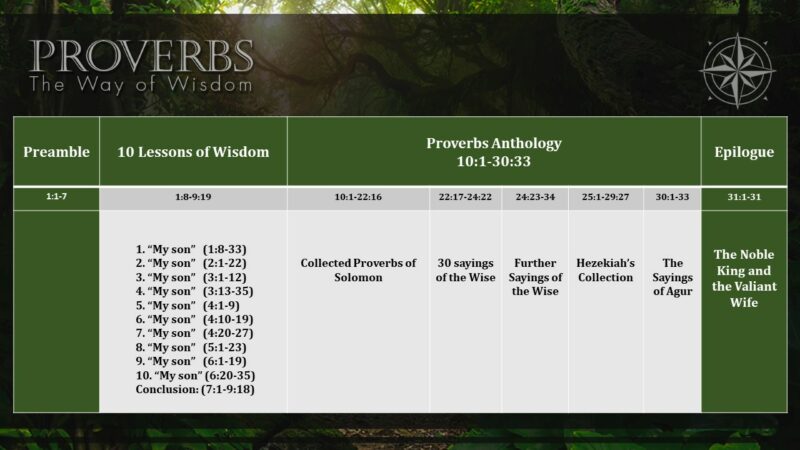
The book of Proverbs divides into 4 main sections. It begins with a preamble (1:1-7), and is followed by 10 lessons of wisdom. (1:8-9:18), which are “didactic poems.” The words “My Son” begins each lesson. The main body of Proverbs is the anthology (Ch 10-30, aka, “Proverbs proper”). This is a collection of those little pithy proverbs, usually one every verse and there’s hundreds of them which apply to every area of life: marriage, work, family, friendship, money, anger, poverty, alcohol, debt, speech, etc. etc. etc. Proverbs concludes with an epilogue (Ch 31), including an acrostic poem.

Outline of Proverbs:

I. Preamble (1:1-7)

II. 10 Lessons of Wisdom (1:8-9:18)

a. Lesson 1 (1:8-33)
b. Lesson 2 (2:1-22)
c. Lesson 3 (3:1-12)
d. Lesson 4 (3:13-35)
e. Lesson 5 (4:1-9)
f. Lesson 6 (4:10-19)
g. Lesson 7 (4:20-27)
h. Lesson 8 (5:1-23)
i. Lesson 9 (6:1-19)
j. Lesson 10 (6:20-35)

k. Conclusion: (7:1-9:18)

III. Proverbs Anthology (10:1-30:33)

a. The Collected Proverbs of Solomon (10:1-22:16)

i. Proverbs Contrasting Righteous and Wicked (10:1-15:29)
ii. Proverbs about the Lord and His King (15:30-22:22)

b. Other Collections of Proverbs

i. 30 Sayings of the Wise (22:17-24:22)
ii. Further saying of the Wise (24:23-34)
iii. Collection of Hezekiah’s men (25:1-29:27)
iv. The Saying of Agur (30:1-33)

IV. Epilogue – The Sayings of King Lemuel (Prov 31:1-31)

a. The Noble King (31:1-9)
b. The Valiant Wife (31:10-31), an acrostic poem.

Challenge:

During this series, we want to challenge you to read the book of Proverbs. One chapter per day. Stay tuned for more posts on this amazing source of God’s wisdom. 

To watch our sermons in this series, go here

Here are some recommended resources on the book of Proverbs:


References: 

(a) A note about authorship: As a cultural backgrounds point, the antiquity of Egyptian literature leads one to have no trouble accepting the authorship of Solomon. The “Instruction of Amenemope” has a very similar structure with main title, prologue and main text as a collection from the same time period. There may even be a direct quote of Amenemope in Proverbs 22:20 in the “thirty sayings.” For more on this go here. It is therefore reasonable to render Solomonic authorship to most of Proverbs. Those who question Solomon’s authorship inconsistently regard attributions to Hezekiah, Agur, and Lemuel as authentic. Other collections of Proverbs inside the book were added later and the book had a final editor.

(b) Definition taken from the ESV Study Bible (p 1130)

(c) Scott, The Way of Wisdom in the OT, (1971) p 22. 

(d) Scott, The Way of Wisdom in the OT, (1971) p 58. 

Five Lessons From Preaching Through Romans

Today marks the end of a chapter. Chapter 16 of the book of Romans that is. Over the course of the past six months, we have had the joy of preaching through this amazing letter. Some say it was the most important letter ever written. This isn’t my first time passing through, but Romans is like a favorite vacation spot. There’s always somewhere to come back to, revisit, or see some things I didn’t have time to see last time I was there. It was a joy. Here are five lessons I have learned from this past trip, corresponding to the five major sections of the book of Romans:

1. Our Understanding of Sin is too Shallow. (Rom 1-3) One of the biggest lies of our culture is that most people are basically “good.” If there is anything wrong with us, “Tis’ but a scratch…only a flesh wound!” (any Monte Python fans out there?) We are in bad shape. So many people think they are “good enough” and they will make it to heaven. Paul comes from the exact opposite perspective. The question of Romans 1-3 is not how could God condemn anyone? Rather, it is how could a Holy God actually forgive anyone and still remain Just? It’s not about how could He allow anyone to go to Hell, it’s about how could He allow anyone into Heaven? We tend to think of sin as breaking the law or making mistakes. It’s MUCH deeper than that. Sin is about curving everything in toward the self. Sin is the deep self-deception of pretending we are justified in living as if there is no God we are accountable to, even while we are breathing His air. Sin is cosmic treason. The problem worsens when we remove God, as a vacuum is left and so idols fill the void. We give ourselves over to these false gods in living sacrifice to them … money, fame, renown … around which we center our lives. The problem is there is no life in these things, only death. This is the sad state of humanity and the bad news message of Romans 1-3. 

2. Our Culture Is Confused About the Gospel. (Rom 4-5) The gospel is about a great exchange, the exchange of the righteousness of Christ for the filth of our sin made possible because of the substitutionary atonement on the cross and His victory over the grave. We come by faith alone with empty hands to receive this gift. We bring nothing … but our sin. This is the message of Romans 4-5 and this is the difference between Christianity and every other religious system. We need to clarify the true gospel. Despite what we hear on TV, the Gospel is not a promise that life will go well when we enter a relationship with Jesus. When God saved us from our sins, we escaped his coming wrath but we don’t get to escape all the hardships that come along with this life. The recent film, “The American Gospel: Christ Alone,” does a great job explaining the confused gospel problem of our age. 

3. Our Spiritual Formation Process is Anemic. (Romans 6-8) There is a victory in the spiritual life that is available for us that few are even aware of. We are in need of an overhaul of our discipleship strategies. The power of sin can be broken through our identification with Christ in baptism and there is more freedom available. The puritans are a wonderful resource in this area, such as John Owen’s book, “The Mortification of Sin”, an absolute treasure trove. Chains can be broken. We can be free. We need to grow. 

4. Our God is Sovereign. (Romans 9-11) Paul presents to us a very big God who is in complete control of all things. We don’t understand it all, and that’s actually good. Not all things are good for us to know, and so God has not revealed them to us; and there are some things that are good for us to know, even when we can’t explain them fully. God’s sovereignty is one of those things. In Romans 9, Paul says, “But who are you, O man, to answer back to God? Will what is molded say to its molder, ‘Why have you made me like this?'” (Romans 9:19-20). C.S. Lewis described this well, “The ancient man approached God . . . as the accused person approaches his judge. For the modern man the roles are reversed. He is the judge: God is in the dock. He is quite a kindly judge: if God should have a reasonable defense for being the god who permits war, poverty and disease, he is ready to listen to it. The trial may even end in God’s acquittal. But the important thing is that man is on the Bench and God in the Dock.”* We need to know our place. John Piper’s book “The Justification of God,” is the most thorough work on this subject in our generation. 

5. Our Churches are way too Disunified, Unnecessarily. (Rom 12-16) Final lesson, the gospel is leading us somewhere, to a life of complete transformation, which impacts every sphere of our lives, our relationship with God, ourselves, our government, and even our enemies. Reading through Romans this time highlighted for me how Paul begins to speak to each faction in the church (Jew and Gentile) from the very beginning. The conflict which becomes clear in chapter 14 has been on Paul’s mind as he writes this theological treatise and much of this book is the necessary groundwork to create peace between these disunified church members. What’s the problem? Gray areas. Meat sacrificed to idols. Differing Opinions. We may not struggle with the same disputable issues they did, but we have our own and the same tendencies of a) judgment or b) ridicule on both sides are still dividing the church today. We should work hard at acceptance, love and church unity or we are doing the devil’s work for him. The gospel makes all of this possible. 

I finished this trip with fresh reminders of how the Gospel puts into our hands the very power of God for salvation, for growth and for authentic community. I have a lot more to learn. Every single week of preparation there was more I wanted to study. I wish I had more time, but alas, a new series awaits us. I will need to plan another trip back to visit this letter again… 

To watch the messages on Romans in this series, you can go here

References:

*”God in the Dock,” in Lesley Walmsley, ed., C.S. Lewis: Essay Collection and Other Short Pieces [London: HarperCollins Publishers, 2000], p. 36)

Here are some commentaries on Romans I found helpful in preparation for this series: 

What Masks Reveal About Our Spiritual Lives

Are Masks Cool… or Odd?

When I was a child, I loved to wear masks. This reality can be attributed to the fact the I was a young boy who loved superheroes. After all, Batman wore a mask, Iron Man wore a mask, Spiderman wore a mask… masks were cool! Conversely, wearing a mask as an adult until recent memory seemed… odd. Unless you had a legitimate need to secure a mask on your face, why would you?

Nowadays, we are required to wear masks to go to the store and anything else involved in daily life. I think I speak for most people when I say that it is already becoming tiresome; not only are we socially distancing ourselves from others, but masks aide in further emotionally distancing us from our fellow image bearers. Someone recently commented to me, “People can’t see when I smile—they can’t read my face!” We take for granted how important face to face interaction is in life.

What’s interesting is that, in the history of dramatic presentations, masks were used to convey emotion, not remove it. The famed drama masks you can find on simple google search reveal two important emotions: laughter and sadness. Comedy and tragedy. Drama masks revealed emotions; pandemic masks conceal them.

The Psychology of Masks

The reality, however, is that we were already wearing masks in our everyday life… just not physical ones. We all wear metaphorical masks that are designed to prevent people from knowing our true selves. We wear these masks to present an illusion, to make it seem like we are living the perfect life. These masks are decorated with our titles, our possessions, and our achievements. Think about your response when someone asks the question, “Who are you?” More often than not, we respond by describing what we do—“I’m Bob Erbig, and I am a pastor.” We shy away from describing who we truly are—“I’m Bob Erbig, a sinner saved by the grace of God who still has a long way to go.”

What mask do you wear?

Spiritual Revelations

By now, you are probably considering how this intersects your spiritual life. In our pandemic moment, God is using our new normal of mask wearing to reveal the true state our inner lives.

  1. We are PRONE to hide.

We cannot assess the state of our inners lives without examining where we came from. You may remember the Genesis account of the fall, detailed in the third chapter of the book. Our ancestors, Adam and Eve, bring sin into the world by succumbing to the serpent’s deception—they eat the fruit God told them not to. They disobeyed. They rebelled. And rather than confessing this reality to God… they hid. Look at the scene in Genesis 3:8-10, “Then the man and his wife heard the sound of the Lord God as he was walking in the garden in the cool of the day, and they hid from the Lord God among the trees of the garden. But the Lord God called to the man, ‘Where are you?’ He answered, ‘I heard you in the garden, and I was afraid because I was naked; so I hid.’” There is so much packed into those verses, but the bottom line is clear: we are prone to hide. Why do we hide? Adam says it best—we are afraid.

Now think about how this applies to masks. Why do we wear masks when we go to the grocery store? Yes, we are mandated by the state, but we would probably wear them anyway because we are afraid of getting sick. If we apply the same logic to the metaphorical masks we just talked about—we wear them because we are afraid of being discovered as a fraud. We would much rather discuss our accomplishments than our faults. Truthfully, we hide behind our accomplishments, which causes even our closest friends to miss the real “us.” And then we opine that no one truly understands us.

Let me give an illustration—when I was in college I had the opportunity to attend the taping of a popular late night talk show. While it was an incredibly fun experience, I was struck by one reality: there is so much you don’t see behind the scenes. At one point in the show, a band played and the camera only showed the band. As an audience member, I could see the host off to the side looking incredibly disinterested in what the camera was showing. That was something I would never see if I was watching at home!

Do you see my point? We show people what we want them to see—we are prone to hide. But our lives would be so much richer, our relationships would be so much deeper, if we allow the people who love us to see more of us.

  1. God Sees Behind the Mask.

Every time I read that Genesis account, I always wonder how Adam can be so foolish—did he really think he can hide from God? The writer of Hebrews makes it very clear that God sees right through us, “Nothing in all creation is hidden from God’s sight” (4:13a). You can’t hide from God. But the bigger question should be—why would you want to hide from God?

Many people go through life wearing a mask, thinking they fooling even God. I think the reason many people do this is because they fear the consequences of being found out. “If God really knew who I was… he wouldn’t love me. He would punish me.” If that is you, let me share a secret: God already sees behind your mask—he’s God! However, let me address the fear that is causing you to wear a mask. God’s desire is not to punish—God’s desires is to forgive. God’s desire is to give grace. This is the reason Jesus Christ came to die on a cross for us (Eph. 2:1-10). Mercy is available for us at the foot of the cross… God’s desire is that we run to it and confess.

The freeing news of the Gospel is that in Christ, we can be fully known and truly loved. Masks don’t work with Jesus—and we shouldn’t want to wear one anyway. He knows what you’ve done, what you’ve thought, what you’ve desired and he still said, “I will die for you so that you may be made right with your Heavenly Father.” Wow.

The safest place in this world is in a relationship with Jesus Christ.

  1. It Takes Courage to Remove the Mask.

The reality described above is what theologians call justification. We are saved not by what we have done, but by what Jesus has done (Rom. 3:21-26). The rest of the Christian life is about us growing more and more into Christ-likeness. This is what theologians call sanctification. But I want to let you in on another secret: that requires removing the mask.

Will it be scary? Yes, because you will have to confess sin. Will it be painful? Yes, because you will have to forgive and be forgiven. Will it be worth is? Yes, because your intimacy will grow both with God and the people who truly love you. They will know the real you.

I believe most people run away from Christian community because it is hard to remove their masks. Confessing sins is never something we want to do, but it is something that is healthy to do. Of course I recommend you do this with a smaller group of people who love and care for you—it builds intimacy and it grows you more like Jesus.

It takes courage to remove that mask. So the next time you put on that N95 and go to the grocery store, think about what it would look like to take off your other mask with the people you love AND with your Creator.

The Paradox of Loving Our Neighbors… By Staying Away from Them

Does anyone remember what life was like 8 weeks ago? My daily routine would look something like this: get up, take my daughter to preschool, go to work, come home, go to the gym, spend some time with the family and go to bed. I didn’t worry whether there would be toilet paper at the grocery store, or if I could find the right cut of meat for dinner the next day. On top of all that, wearing a mask in public was viewed as something… odd.

What a difference two months makes. In NJ, we are nearing the end of our 7th week engaging in mitigation and social distancing measures. While these measures seem to be effective, there is the compounding challenge of social isolation and anxiety sweeping through our state. Just before the orders went into place, one of my friends made this statement, “The best way to love our neighbors during this time is to stay away from them.” This idea struck an intriguing dissonance in my mind—how does that even make sense?

When tragedy strikes, the first action we want to take as followers of Christ is running to people so we can hug and comfort them. However, to now give someone a hug, or enter their home could prove lethal for some. It creates an odd tension for Christians who want to live out the Great Commission in Matthew 28:19, “Therefore go and make disciples of all nations, baptizing them in the name of the Father and of the Son and of the Holy Spirit.” But, you may ask, how can I make disciples if I cannot be in their presence?

While on a mission trip in Senegal several years ago, I spoke with a missionary who argued that getting sick was worth sharing the Gospel. He was willing to risk his health to tell someone about Jesus and, at the time, I thought that was a noble venture. As we get further and further into this pandemic, I wonder if more discernment is needed. While we desire to live out the Great Commission, we must not forget the Great Commandment in Matthew 22. In this context, the Pharisees, the experts in the law, come to Jesus and try to stump him with this question, “Teacher, which is the greatest commandment in the Law?” (v. 36). Jesus, of course, was never surprised by these questions and quickly offered a response: “Jesus replied: “‘Love the Lord your God with all your heart and with all your soul and with all your mind.’ This is the first and greatest commandment. And the second is like it: ‘Love your neighbor as yourself.’” (v. 37-39).

These verses have been a clarion call for believers throughout the centuries: Love God. Love People. And yet, we find ourselves at a peculiar moment in history… what does it mean to love my neighbor as myself in an era of COVID-19. Speaking from firsthand experience as someone who has had the virus—it would be un-loving of me to pass it on to others… especially those who might be more adversely affected than me. That would not be loving my neighbor as myself, since I seek to avoid sickness.  

So what do we do? How do we love our neighbors as ourselves? Let me briefly mention three action steps to consider.

  1. Be EXTRA Intentional.

When it comes to neighbors, and even family members, we can take those relationships for granted. We live such busy lives assuming we’ll see that neighbor when it gets warmer and we are all outside. Or, we assume we’ll see that family member at the next gathering. But there will not be family gatherings for a while—Thanksgiving dinner may even have to be virtual this year!

All things considered, I would invite you to be extra intentional in your contact with people. A phone call, a letter, a FaceTime exchange all go a long way to letting people know you care. Do these things MORE often. Extra intentionality requires more than a text message. Back when texting first became popular, my sister downloaded a ringtone which played every time she got a message and it said this: “You have a text message, which means someone thinks you are not worth the minute!” Ouch. That stings. Take this time to be extra intentional with your neighbors and your family.

  1. Be Appropriately Cautious.

At the same time that we are extra intentional in our relationships, we should be appropriately cautious. The other week, my wife and daughter made the 50 minute drive down to my mother’s house to say hello. This was our attempt to connect more relationally with her, but we remained in the car. We took this action, not because we don’t love my mother… but because we do. Drive by greetings may be the way to go for the next season.

However, even stopping by in this manner goes a long way to letting people know you care. How might you do this for your family and neighbors?

  1. Pray for Them.

People often ask, “How are you spending your time in quarantine?” Many people are using this crisis to expand their Netflix viewing, or catch up on reading. But I would challenge every reader to use this time to expand your prayer life. Take time to pray for your neighbors and those you love—daily. As you take the time to pray for people, they will burden your heart more often and cause you to take the first two actions I mentioned in this post.

Take time, right now, to write down three people you can pray for over the next month. Pray for them each day. Pray that God would use this season to awaken their heart for Jesus, maybe even for the first time. And then back it up with intentional, caring action.

When I think about it, I want people to do that for me. If I am going to love my neighbor as myself… I should care for them as I would myself. Be extra intentional. Be appropriately cautious. Pray. Pray. Pray.

And when you do, who knows what doors God will open for the spread of the Gospel.

Our Christian Hope in the Middle of a Pandemic (Part 4)

Previously on this blog we have discussed rightly interpreting the promises of God and the “already / not yet” model of the kingdom in this age. In this blog post, we will examine this question – how can we as Christians uniquely bring joy and hope even in the midst of deep sorrow?

Let me begin with an image from a film based on the true story of the Apollo 13 crisis. There is a scene in the movie where flight director Gene Kranz overhears two NASA directors discussing the low survival chances for the crippled spacecraft …  “I know what the problems are Henry,” one of them says, “this could be the worst disaster NASA has ever experienced.”

Gene Kranz responds with great wisdom, “With all due respect, sir, I believe this is going to be our finest hour.” 

Lessons from Church History

While this whole thing is brand new to us, this is not the first time the church has been through such times. Christians have faced many epidemics over the past 2,000 years, and our brothers and sisters in the past have much to teach us. I have been reading this week about the Spanish flu from 1918 and how churches closed for several weeks back then. There was the terrible Antonine Plague of the 2nd century, which might have killed off a quarter of the Roman Empire, yet the church survived. Soon thereafter, there was the famous epidemic called the Plague of Cyprian, named for a bishop who gave a colorful account of this disease in his sermons. The church historian Pontianus recounts how Christians ensured that “good was done to all men, not merely to the household of faith.” Our witness was so strong that even the pagan Emperor Julian spoke of how “the Galileans” would care for even non-Christian sick people. 

In the middle ages, when the bubonic plague hit Wittenberg (in 1527), the reformer Martin Luther refused to flee the city and protect himself. His refusal to flee cost his daughter Elizabeth her life. Luther produced a tract entitled, “Whether Christians Should Flee the Plague,” which states, “We die at our posts. Christian doctors cannot abandon their hospitals, Christian governors cannot flee their districts, Christian pastors cannot abandon their congregations. The plague does not dissolve our duties: It turns them to crosses, on which we must be prepared to die.”

To modern people living after the discovery of the germ theory, this can all sound a bit foolish. But this is not what they understood. For them, their staying was an act of self-sacrifice and took great courage. Today of course we understand that staying to care for the sick with close proximity is likely to infect others and make the problems worse. So now, we socially distance, not to protect ourselves, but to protect others, so we follow the rules and pray for strength for our neighbors, especially the health care providers who are on the front lines. Nonetheless, the point in looking back is this, Christians have weathered these storms before with a spirit of generosity and sacrifice … and grown stronger because of them. The watching world was stunned by our love (John 13:35).

What does Love Call us to do? 

Love is our mark. In every age, we should be asking ourselves this question: What does love call us to do? Love calls us to utilize technology and stay connected. Love calls us to lend a hand to do grocery shopping or run errands for those who can’t get out. Love means checking on the elderly and serving the immuno-compromised. Love means holding out a great hope even in the midst of the fear all around us.

The Christian gospel and the great hope is not immunity from all suffering and disease. The Christian message is that even in the midst of great tragedy, we say that God is good and He has not forsaken us, even though this fallen world is broken. To the healthy, we urge vigilance and the call to serve our neighbor. To those infected, we pray for healing and we hold out hope. To all, we point to Christ’s promises which never fail. To those suffering, we point to Christ’s presence, as He is sufficient and He will never leave us nor forsake us. Evil and harm cannot separate God’s children from His love, nothing can separate us, that includes even pandemics.

Let me leave you with a great quote from the great Mr. Rogers. He said, “When I was a boy and I would see scary things in the news, my mother would say to me, “Look for the helpers. You will always find people who are helping.” 

Dear Christian brother or sister: May people look for the helpers … and find you.  

[ Part 1 ] [ Part 2 ] [ Part 3 ]

References: 

Rodney Stark. The Rise of Christianity: How the Obscure, Marginal Jesus Movement Became the Dominant Religious Force in the Western World in a Few Centuries.  (San Fransisco: Harper, 1997).  


Our Christian Hope in the Middle of a Pandemic (Part 3)

In our earlier posts (Part 1 and Part 2), we have discussed the importance of rightly interpreting the promises of the Scripture. Now we will discuss what is called “The ALREADY / and the NOT YET” model of the kingdom of God. This is the age in which we find ourselves in, the age of the church. 

Matt Chandler, no stranger to suffering as he recently survived brain surgery on a malignant tumor, recently release a book called “Joy in Sorrow.” In a recent interview about his book with The Gospel Coalition, Chandler said many Christians are “ill-prepared theologically to understand suffering.” Chandler said, “The errors tend to be, people have an over-realized eschatology or an under-realized eschatology. And when you err in either one of those directions, it actually adds a greater burden to the suffering itself.”

Under-Realized Eschatology

Some Christians err on the side of under-realized eschatology and say things that are “incomplete.” “With under-realized eschatology, all you’ve got is the will of God,” Chandler said, “So ‘whatever the will of God is, that’s what’s gonna happen. Don’t even worry about it. Just ride it out.’” This mentality, Chandler contended, does “great harm to people who suffer and who want to be healed” and indicates that the desire for healing is “somehow ungodly.” The mindset of “Whatever will be will be” is just too fatalistic and it’s not biblical. The Scriptures point toward a God who hears and who intervenes. The Scriptures teach us that prayer matters and we have not because we ask not. (Js 4:2) Yes, ultimately we accept God’s will and pray for the serenity to do so, but not with a passive attitude of resignation. We are called to fight the good fight of faith.

Over-Realized Eschatology

Chandler continues saying, although well-meaning, those who err on the side of an over-realized eschatology tend to cherry-pick Bible verses and say things that “just aren’t true… and I think well-meaning brothers and sisters … in that really dark moment, the impulse is, ‘let me bring hope,’ when really you should bring presence.” Instead, we’ve got these old taglines, platitudes and fake promises: ‘A breakthrough will happen. God will heal.’” 

Chandler says that over-realized eschatology can be “so devastating,” however, because it “doesn’t leave any space for someone to die, or for someone to get cancer, and then ultimately die of that cancer without putting a weight on them that the word of God does not put on them.” This is my concern with some of the responses I’ve seen to our current epidemic. I think what Chandler is saying here is not that we DON’T want to bring hope, of course we do. What he is saying instead is we want to bring hope in this life, hope in this physical realm with certainty, and in doing so this is going too far. The Christian hope we bring is not always healing in the physical realm, at times this is healing in eternity. And today, we bring our presence, we promise to be “with” our brothers and sisters in pain, and we offer assurance of God’s presence, who will be “with us” to the end of the age (Matt 28:18-20).

Three Viable Options

While there is a great mystery involved in discerning the will of God in these areas, the Scripture speaks to three possible outcomes for the children of God when faced with trials:

Option 1: Sometimes God keeps us FROM the trial.

We don’t even know how often God in His grace does this for us, but it is probably countless times in our lives that He has placed over us His hedge of protection and told the enemy, “YOU MAY COME THIS FAR BUT NO FURTHER.” God can do that and does that all the time.

Option 2: Sometimes God keeps us THROUGH the trial.

For example, in Daniel 6 when Daniel was thrown in the lion’s den, while God could have kept Daniel FROM that whole ordeal, that was not His purpose. Instead, there were lessons that Daniel and those around him would learn that could only be learned by Daniel going into the Den of Lions. This is very important. We need to realize that God is not always committed to our “comfort,” He is committed to our “character.” Sometimes it takes going through trials to shape us. I think we all know that it’s in the trial where God does his best work. Sometimes God brings us into a season of temporary deprivation for our own purification. This is important, often people think that God must always choose option 1, but that is not what we read in the Bible. So, if you honestly believe that because you came to faith in Jesus that as a result God has promised you a “tragedy–free” life, with no hurts, no enemies, no sicknesses, no financial problems, If you think that Jesus promised to put you in a protective bubble where nothing bad can happen to you … the problem with that way of thinking is when you get hit hard by those things, rather than running to Jesus for comfort and help you will instead run away from Him in anger and in disappointment with God. And then you will become bitter toward God himself. Friends, that’s a bad place to be. Trials are hard and grueling, but if we know and love God, then they are never senseless. They are always purposeful to refine us, or to prepare us for what’s ahead, and bring greater fruitfulness in our lives. But we must acknowledge that other times, God has another outcome for his children and it’s this:

Option 3: Sometimes God uses the trial to DELIVER US to Himself.

Throughout the scriptures and throughout church history, there have been countless saints who have gotten sick, suffered, died and even become martyrs who stood firm to the end and God took them home. Is that because those believers lacked faith? No, it’s just that God had another purpose in their lives. Here is our greatest hope, since Christ has conquered even death, as believers we can face this outcome without fear. The worst thing that could ever happen to us is not death. The worst thing that could happen to us is being abandoned from the presence of our Heavenly father for eternity, being separated from my creator, because of the judgment of God. However, because Jesus experienced abandonment from the father on the cross on our behalf, when we have faith in Christ, we do not need to ever face this fear, because this already happened to Christ, in our place. Therefore, when a believer’s life is taken, they depart and are with Christ which is better by far. (Phil 1:20-21). The kingdom of God continues to march forward.

Therefore, for the child of God, there are three possible outcomes and whatever God chooses to do whether it’s option 1, 2 or 3, we always have the opportunity to give Him glory as God, no matter the outcome. Let’s go back to the example of Daniel 6 for a moment, in that story, God could have chosen OPTION 1, and kept Daniel from the den, but if God had done that, not only would Daniel have missed the lion, but he would have missed the angel of God who shut the lion’s mouth! And I’ll bet if you would have asked Daniel, he would say, “I wouldn’t trade that night for anything!”
And so whatever option we face, God’s challenge to us is always the same in trials, God says, “TRUST ME.”

After Chandler’s cancer treatment, I remember watching a sermon he preached on suffering and I’ll never forget what he said to his congregation, he said: “I want you to look right up here at me. Following Jesus is not going to make you wealthy. Following Jesus does not guarantee that you’re going to be healthy. The message of Scripture and the gospel of Christ is NOT that in following him everything goes right, but that He is enough no matter what happens… Jesus is enough.”

Christian, you may lose other things – but you will never lose Christ. There is only one guarantee for the Christian in this life—that your life is hidden with Christ and you have been given eternal protection as an adopted child and heir of God. God’s children are hidden with Him and their soul is safe with Him for all eternity. And so when we are hit hard by the waves of suffering, we say with the hymn writer:

“When all around my soul gives way, he then is all my hope and stay,

in every high and stormy gale, the anchor holds within the veil…

… on Christ the solid rock I stand, all other ground is sinking sand.”

What is the right balance? Chandler said, “I want us to believe together. I want us to ask for the gift of faith while we’re praying and expect God to heal while always having our hands wide open, and believing that God is sovereign and good and He can be trusted with this outcome,” Chandler declared. “So under mercy and not under wrath, suffering then is used according to the Bible, as a purifier, as something that draws us near to the Lord and has us understand that He is drawing near to us,” Chandler explained. “It is used to mature and build … is not punishment for the Christian.” As a Christian leader, I believe we must be careful to strike this balance in a moment like this.

Challenge:

So here’s a challenge for all of us to think through, in times of crisis, which way do you tend to lean? Over realized eschatology or under realized eschatology? How might your personal approach benefit from more balance?

In our next blog post (Part 4) we will discuss what is our distinctively Christian hope. 

[ Part 1 ] [ Part 2 ] [ Part 4

References:

Matt Chandler, Joy in the Sorrow: How a Thriving Church (and Its Pastor) Learned to Suffer Well. (Epsom, Surray, England: The Good Book Company, 2019).

Matt Chandler’s interview with Gospel coalition: https://www.christianpost.com/news/matt-chandler-many-christians-are-ill-prepared-theologically-to-understand-suffering.html

Our Christian Hope in the Middle of a Pandemic (Part 2)

In part 1 of this blog post, we discussed the mixed messages being sent by Christians during this pandemic. We discussed the meaning of Psalm 91 and our ultimate promise of divine protection. In this post we will dive deeper into the concept of God’s promises. 

Which Promises in the Bible Are For Me?

Jen Wilkin wrote an excellent piece on the topic of bible promises. She listed several pitfalls to avoid. Some of these were 1) Confusing a promise with a principle 2) Ignoring the context and 3) Overlooking the “if.” Psalm 91 was written to the people of Israel who were living under the Mosaic law or the “Old Covenant.” We no longer live in this age. All the Bible is inspired, but it was not all written to every person of every age. Israel was a theocracy established by God who gave them the Law as their constitutional covenant. This covenant was a bilateral (two-sided) covenant and it contained conditional blessings. If you go back and read all the covenant blessings (and curses) given to Israel, you will notice how closely connected they are to “the land.” The blessings include things like protection from political enemies, large bounties of food supply, and overall national safety.

Old Covenant Promises

God laid out very specific blessings (for obedience) and very specific curses (for disobedience) for His people, Israel. Jen Wilkin states: “Promises that contain an “If” require some form of obedience before we can expect them to come to pass in our lives. They are conditional. If we want to claim them, we had better be ready to act in obedience to what they require … Often “if” promises of blessing are accompanied by corresponding “if” warnings about disobedience.” We find all these conditional blessings and curses spelled out in detail in places like Deuteronomy 28 and Leviticus 26. For example, Deuteronomy 28:20-22 says this:

The Lord will send on you curses, confusion, and frustration in all that you undertake to do, until you are destroyed and perish quickly on account of the evil of your deeds, because you have forsaken me. The Lord will make the pestilence stick to you until he has consumed you off the land that you are entering to take possession of it. The Lord will strike you with wasting disease and with fever, inflammation and fiery heat, and with drought and with blight and with mildew. They shall pursue you until you perish.

Or as we read in Leviticus 26:23-25:

If in spite of these things you do not accept my correction but continue to be hostile toward me, I myself will be hostile toward you and will afflict you for your sins seven times over. And I will bring the sword on you to avenge the breaking of the covenant. When you withdraw into your cities, I will send a plague among you, and you will be given into enemy hands.

New Covenant Promises 

I was trained for ministry at Dallas Theological Seminary under a system of theology called “Progressive Dispensationalism,” whose proponents see a clear distinction between Israel and the Church. The Church is the gathering of Jews and Gentiles, set apart by God to be cross-cultural. The Church does not function under the old covenant. We don’t sacrifice animals anymore or follow many the ceremonial or civil laws given to Israel. We are not tied to a geographical land or under a centralized government. We are also not promised the kinds of material blessings of the Old Testament, instead we are the recipients of spiritual blessings in Christ (Eph 1:1-15). The blessings of the new covenant include amazing promises of forgiveness, eternal salvation, the presence of God, spiritual gifting and much much more. But, these blessings of the new covenant are not primarily physical.

When we as New Covenant believers reach back into the Old Covenant, we can get into difficulty theologically if we don’t interpret these texts properly. Claiming the promises or blessings of the Mosaic covenant for obedience implies we must also be held accountable for the covenant curses for our disobedience. That’s the deal with law. We cannot pick and choose. If we want to go back under the law, then that means we have to go back under the whole law (Gal 5:3). It’s all or nothing. The main problem with the old covenant was that no one could keep it. The law pointed us toward our need for the Messiah and for His redemption.

Enter Jesus. Even in the midst of the Old Covenant there was a New Covenant predicted in Jeremiah 31, instituted by Christ at the last supper and enacted through His death and resurrection. Let me be clear, living under the Mosaic law is not a viable option for the Christian. The old covenant is now obsolete. (Heb 8:13). Paul states, “If righteousness could be gained through the law, Christ died for nothing!” (Gal 2:21 NIV) New Testament believers need to be very careful how they appropriate the promises found in the old covenant, a covenant involving very material and earthly rewards.

In this age, New Testament Christians experience hardship, trials and pain, but all with great hope. Sometimes we in the church may see God’s powerful hand in miracles, other times believers may sometimes get sick, sometimes even get infected with a virus, and sadly sometimes die. As Christians, we grieve these losses as a result of the Fall and we receive comfort from God (2 Cor 1:1-10; Matt 5:1-10). The comfort we receive is that we never grieve without hope. His promises include His unfailing presence, our future hope in heaven, and our ultimate bodily resurrection. Here is an example:

Do not be afraid of what you are about to suffer. I tell you, the devil will put some of you in prison to test you, and you will suffer persecution for ten days. Be faithful, even to the point of death, and I will give you life as your victor’s crown. (Rev 2:10)

We proclaim that God is still good even in the midst of the difficulty and His glory triumphs – even in our suffering. The apostle Paul says it this way:

“We are hard pressed on every side, but not crushed; perplexed, but not in despair; persecuted, but not abandoned; struck down, but not destroyed. We always carry around in our body the death of Jesus, so that the life of Jesus may also be revealed in our body. For we who are alive are always being given over to death for Jesus’ sake, so that his life may also be revealed in our mortal body. So then, death is at work in us, but life is at work in you.” (2 Cor 4:8-12, NIV).

The Key of Promise

John Bunyan in his classic allegorical work, Pilgrim’s Progress, writes about a scene that deeply moved me when I first read this work years ago. Toward the end of the book, the main character Christian, who has been on a journey to the Celestial city, (which is a metaphor for the Christian life), veers off the difficult path to try and find an easier, smoother way, and that’s when he and his traveling partner, Hopeful, get captured by a vicious sadistic giant named Despair. The giant found them sleeping on his property and brought them back to his home, called DOUBTING CASTLE, and threw them into his dungeon. They began to pray and suddenly Christian remembered something, “What a fool am I, thus to lie in a stinking dungeon, when I may as well walk at liberty! I have a key in my (pocket) called Promise, that will, I am persuaded, open any lock in (this) Castle.” So they tried the key of promise in the dungeon door and it opened. 

Here’s the note from John Bunyan included at the bottom of the page — “Precious promise!  The promises of God in Christ are the life of faith, and the quickeners of prayer. Oh how oft do we neglect God’s great and precious promises in Christ Jesus, while doubts and despair keep us prisoners.” 

God’s promises are powerful in fighting despair. What are the promises we can hold onto? As Christians we long for Christ’s promise return. We have His promise of His Presence (Matt 28:19-20). We hold onto the Promise of His love (Rom 8:28-39). We have His promise of Wisdom (Js 1:1-5). We have His promise of strength in weakness (2 Cor 12:9-11). We have His promise of a peace that passes understanding (Phil 4:7). These are our great and precious promises (2 Pet 1:4). 

Until Christ returns to make all things new, we live in between these times. We live in what theologians call the “already / and not yet.” We will discuss this concept further in Part 3.

[ Part 1 ] [ Part 3 ] [ Part 4

References

Bunyan, John The Pilgrim’s Progress. Edited by Roger Sharrock and J. B. Wharey. (Oxford: Oxford University Press, 1975). Originally Published in 1678. 

Jen Wilkin’s full article referenced in this blog: https://www.thegospelcoalition.org/article/which-promises-are-for-me/

Darrel Bock. Progressive Dispensationalism. (Ada, Michigan: Baker Publishing Group, 2000)