

Why would God do this? Did we do something wrong?
My wife whispered these words through tears as we sat in our car after a 16-week ultrasound revealed skeletal malformations in our unborn son. After years of trying, multiple miscarriages, and finally the joy of pregnancy—why would God allow this?
It was in that raw moment that the Spirit brought John 9:3 to my mind: “It was not that this man sinned, or his parents, but that the works of God might be displayed in him.”
This happened so that he could be a canvas for God’s glory.
A Tale of Two Pools
John’s Gospel gives us two healing stories that address our deepest questions about suffering. At the Pool of Bethesda, we meet a man sick for 38 years—lying in the “House of Mercy,” yet experiencing none. Jesus asks him: “Do you want to be healed?”
It seems obvious. But Jesus’ question cuts deeper than physical restoration. He’s asking: Do you see me for who I truly am?
When we encounter disability, our response opens a window to our soul—revealing our desires and exposing our relationship with God.
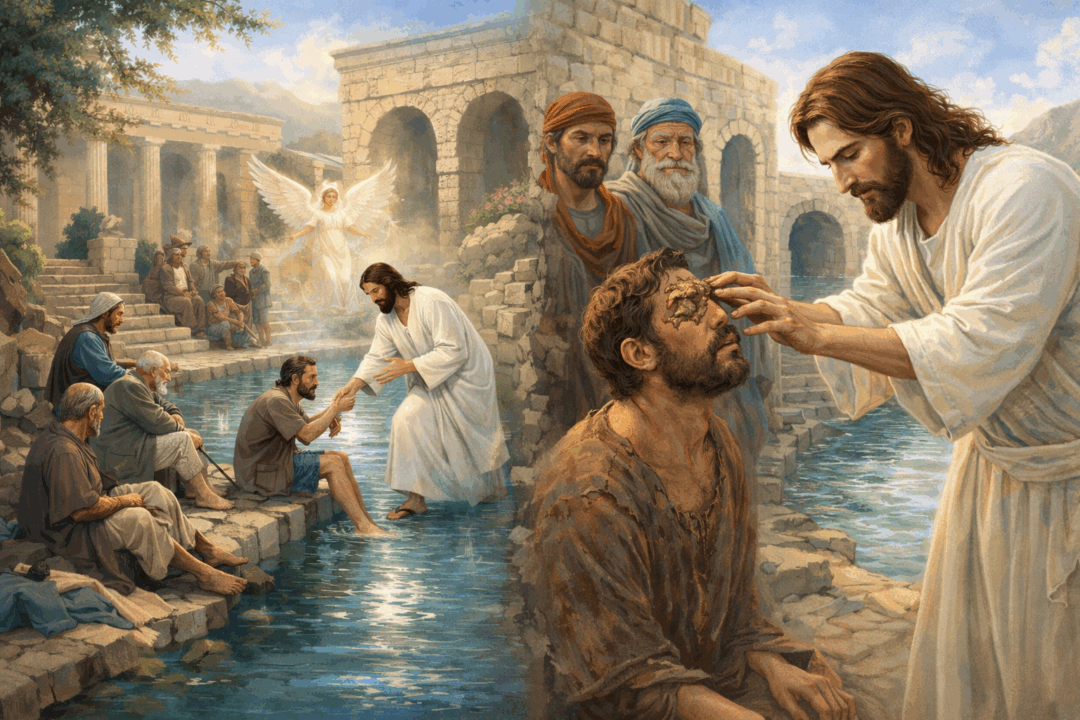
At the Pool of Siloam, we find Jesus with a man born blind. His disciples ask the question that haunts every family touched by disability: “Rabbi, who sinned, this man or his parents, that he was born blind?”
The assumption behind their question was common in first-century Israel: disability equals divine punishment. Someone must be at fault. And honestly? This assumption persists today.
But Jesus turns their thinking upside down: “It was not that this man sinned, or his parents, but that the works of God might be displayed in him.”
From “Why?” to “What Now?”
Here’s the fundamental reorientation Jesus offers: Stop looking for answers in past causes and start looking for future purposes. The question is not “Why did this happen to him?” but rather “What will God accomplish through him?”
When my wife and I sat in that car after our ultrasound, we encountered a fork in the road. We started with the first question—Why did this happen? And I suspect many of you have been there, weeping, wondering. I want you to know: that’s natural. It’s okay to start there.
But I also want to challenge you not to stay there.
As painful as it might be, ask God to help you move to the second question: What will God accomplish through this?
That path leads to surrender. It won’t be easy—but God will get the glory.
My son Josiah’s life has been exactly that. There were times we didn’t think he would survive—but he did, because the church prayed. He required a bone marrow transplant at 11 months old—but he survived, because the church prayed. And God received the glory.
It has not been easy. Yet God has built resilience I never thought possible. He has drawn us close in prayer and developed tender hearts in our daughters. Every time we weren’t sure we would make it—he has always provided.
Jesus Sees, Jesus Restores, Jesus Sends
Notice what Jesus does. At Bethesda, he “sees” the man the world overlooks. He knows the man has waited “a long time.” People with disabilities understand this—the waiting for others to notice, the patience required, the endless hours in doctors’ offices.
Jesus knows about our “long time.”
At Siloam, Jesus doesn’t just heal—he re-creates. When he makes mud with his saliva, John uses the same Greek word (pelos) found in Genesis 2:7 describing Adam’s formation. This is new creation imagery. And the pool’s name—Siloam, meaning “Sent”—embodies Jesus’ identity as the one sent from the Father.
The man washed and came back seeing. For the first time in his life, his eyes were open—and he saw Jesus, the one who healed him.
Our Calling
Why does this matter? Because Jesus sees the overlooked, restores the forgotten, and sends his church to do the same.
Modern pools of Bethesda exist all around us—emergency rooms, care facilities, educational systems with waitlists. Sometimes even churches can leave people isolated while they wait for the water to stir.
We cannot be the full body of Christ without those with disabilities. They have so much to teach us. We cannot leave them at the pool—we must bring them to Jesus, the Light of the World.
So let me leave you with two questions: When you encounter disability, it’s natural to ask, Why would God do this? But I also want to challenge you to ask, What will God accomplish through this?
God hasn’t forgotten you. He wants to bring you to a place of surrender—and then he will use you for his glory. As you walk with him, like the blind man, he will open your eyes to see.
My son Josiah smiles, runs, and lights up when I come home. He gives hugs. He has joy. And by God’s grace, with many more years to go, he will be a canvas for God’s glory.
Jesus sees the overlooked, restores the forgotten, and sends his church to do the same.
4-Day Scripture Reading Plan: The Canvas of Glory
Day 1: Seen by Jesus
John 5:1-15
Jesus sees those the world overlooks. Reflect on areas where you feel invisible or forgotten, and ask Jesus to meet you there.
Day 2: Purpose Over Punishment
John 9:1-12
Disability and suffering are not divine punishment—they’re opportunities for God’s glory. Ask God to shift your perspective from “Why?” to “What will you accomplish?”
Day 3: Light in Darkness
John 9:13-41
The healed man boldly testified despite opposition. Consider how your own story of God’s faithfulness can encourage others.
Day 4: Sent to See
John 7:37-39; 9:4-7
Jesus is the Living Water and the Light of the World—and he sends us to bring others to him. Pray for eyes to see those waiting at the pool and courage to bring them to Jesus.