

The Problem with New Year’s Resolutions
Every January, we make resolutions with the same underlying assumption: something in us needs fixing before we’re useful. We resolve to be smarter, stronger, healthier, more financially secure. None of those goals are wrong—but they reveal something about us. We are catechized by a story that says strength is the goal and weakness is the problem.
What if that story is wrong?
What if the very weaknesses we’re trying to eliminate are the places God intends to display His glory most clearly?
Our culture is obsessed with competence. We celebrate productivity, independence, and self-sufficiency. Weakness—especially visible weakness—makes us uncomfortable. Disability, limitation, dependence… these are things we’d rather manage quietly or avoid altogether.
Even in the church, we can subtly absorb these values. We talk about grace, but live as if God works best through the capable. We imagine God will use us more once we’re healthier, less overwhelmed, or finally “put together.”
But Scripture confronts that assumption head-on.
Good Chooses the Weak to Shame the Strong
The Apostle Paul writes words that dismantle our strength-based instincts:
“But God chose what is foolish in the world to shame the wise; God chose what is weak in the world to shame the strong; God chose what is low and despised in the world, even things that are not, to bring to nothing things that are.”
(1 Corinthians 1:27–28)
Paul reminds the Corinthian church—and us—to consider our calling. God did not wait for His people to become impressive. He did not choose them because of wisdom, power, or status. He called them as they were.
And that is the point.
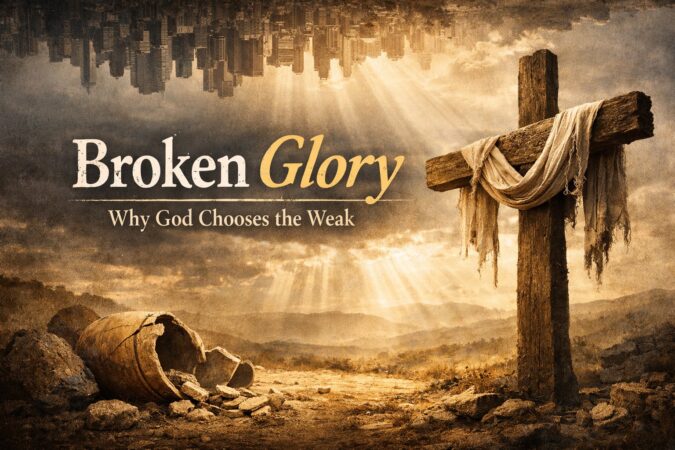
God’s Kingdom operates on an upside-down value system. Weakness is not an obstacle to His purposes—it is often the instrument. The cross itself is proof. Jesus did not conquer through dominance but through surrender. Divine power was revealed through human frailty.
This truth reshapes how we see disability. Disability is not a loss of humanity. It is a form of human experience within a broken creation—one in which God’s image remains fully present and God’s grace is powerfully displayed.
Scripture affirms that every person bears the image of God. That image is not measured by intellect, productivity, independence, or physical ability. To be human is to bear it. And because of that, every life is worthy of honor.
Do You Truly See?
For me, this became personal when my son Josiah was born with a rare genetic condition. Until then, I was aware of disability—but I didn’t truly see it. God used my son’s life to expose how shallow my instincts about strength really were.
Josiah has taught me what joy looks like. What dependence looks like. What unfiltered worship looks like.
And I’ve learned this: people the world calls “weak” often become the clearest witnesses to God’s strength.
But honoring the image of God requires more than agreement—it requires attention. Avoidance rarely looks like cruelty. More often, it looks like distance. It looks like looking away, staying silent, assuming someone else will step in.
What we fail to see, we fail to honor.
Three Invitations:
Paul tells us why God works this way: “so that no human being might boast in the presence of God.” Weakness levels the ground. It exposes our pride. It redirects our confidence.
So here’s the challenge:
-
Lean into your own limitations instead of hiding them.
-
Learn from people whose lives are shaped by disability or dependence.
-
Look again at those you might normally overlook.
Because our limitations are not barriers to God’s glory—they are the stage for it.
And in a world obsessed with strength, may we learn to boast in the Lord alone.
4-Day Scripture Reading Plan
Day 1: 1 Corinthians 1:26–31
Reflect on how God redefines wisdom, strength, and worth.
Day 2: Jeremiah 9:23–24
Consider what it means to boast in knowing the Lord rather than in human ability.
Day 3: Genesis 1:26–27 & James 3:8–10
Meditate on the image of God and its implications for human dignity.
Day 4: 2 Corinthians 12:7–10
Sit with the truth that God’s power is made perfect in weakness.